
about us
Torchbearers of humanity
An encyclopaedia in the spirit of religious tolerance
The work on the religious encyclopaedia entitled the Torchbearers of Humanity began in the year 2000. The collection was compiled in the spirit of religious tolerance and presents the major religious and spiritual treasures of our world through the outstanding figures of spirituality. Additionally, it provides a glimpse into the lives of the founders of religions, saints and spiritual mentors who defined the spirituality of humanity. The three volumes contain the biographies of 222 torchbearers. These are complemented by over 250 beautiful illustrations as well as excerpts from the teachings of the torchbearers, usually captured in the notes of their disciples. The three volumes of the encyclopaedia were published on All Saints’ Day in 2022. In the following, we wish to share a few thoughts about the encyclopaedia itself as well as the various initiatives of rapprochement between religions before touching on the significance of dealing with the figures of the saints and the message represented by their lives.
About the torchbearers of humanity
A close study of the encyclopaedia shows that the great saints and teachers of the world lived in peace and harmony with one another and the wider world. They all professed the belief of mutual tolerance, understanding and acceptance. All of these great figures acted in the spirit of love, setting an example for all ages, including the humanity of the modern age.
In fact, in light of their thoughts, one might have the sense that all the excerpts in the book originate from the same author, as they were all born in the spirit of peace and love. This love and acceptance supports the coexistence of the various religions. It’s as if all religions provide a single colour in the spiritual palette of the world and the colours contribute to the birth of light!
These extraordinary people also had similar notions of the most important issues in life. For the sake of tactfulness and clarity, when professing their beliefs and imparting their teachings, the torchbearers always spoke in due consideration of the mentality of the age, culture and country in question as well as the receptiveness of their audience. For this reason, it might seem at first that their teachings are contradictory in nature, yet essentially they pose no contradiction whatsoever: they all stress the importance of outwardly and inwardly peace, love and assisting others, while their lives represent a message that provides a helpful example and guidance for all those who met them or who study their lives today.
In light of the efforts of the various founders of religions and the saints of various faith, it becomes clear that there is no religion that is not worthy of following. Everyone should choose a religion appropriate to their past, upbringing and mentality, providing them with assistance from their own spiritual-religious surroundings and thus becoming a better human being in the process with a stronger sense of morality.
The encyclopaedia also calls attention to the fact that humanity represents one big family cut from the same cloth and that we are all one in our spirit: brothers and sisters traversing similar paths and faced with similar challenges, yet all our hardships can be eased if we carry on by supporting one another, hand in hand.
On the interfaith dialogue
One of the key aspirations and tasks with the collection was to reduce the distance between the various religions and help the various faiths approach one another and increase mutual acceptance.
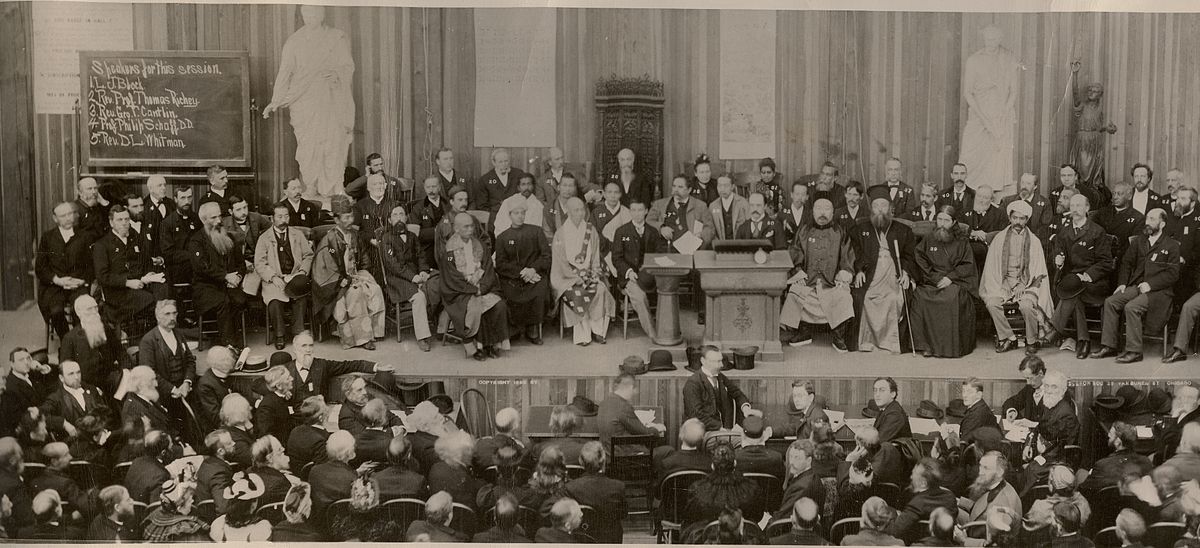
Throughout the history of humanity, there have been a number of efforts to encourage interreligious dialogue. The first instance of this in the modern age dates back to the late 19th century. In this period, arts and science as well as religious life strove for an opportunity for renewal. Within Christianity, the various ecumenical renewal and charismatic movements also date back to this period, along with the first major attempts at organised interreligious dialogue. Interestingly enough, the first event of this nature took place on September 11th, 1893 at the World’s Fair in Chicago. The event was known as the Parliament of the World’s Religions.
This is where Swami Vivekananda delivered his famous speech, which was enthusiastically received by the Parliament, despite the fact that Vivekananda himself wasn’t officially invited to the event and only received an invitation at the very last moment. His famous speech, which was welcomed by a huge round of applause was concluded with the following thoughts: “As the different streams having their sources in different paths which men take through different tendencies, various though they appear, crooked or straight, all lead to Thee.”
The process launched by the event recently achieved yet another important milestone. In 1993, on the centennial of the event, the Parliament of the World’s Religions reconvened, hallmarked by yet another Indian master: the event commenced with joint meditation led by UN Ambassador of Peace Sri Chinmoy.
The next important step was the World Fellowship of Religions convened by Master Sant Mat, Sant Kirpal Singh. Thanks to his efforts and those of his followers, in 1974, at the major religious festival Kumbh Mela in Haridwar, they organised the world conference dubbed “Unity of Man” attended by over two thousand religious and political leaders as well as over fifty thousand spectators. One of the major achievements of the gathering was that it even managed to engage the holy Sadhu, who have renounced worldly life.
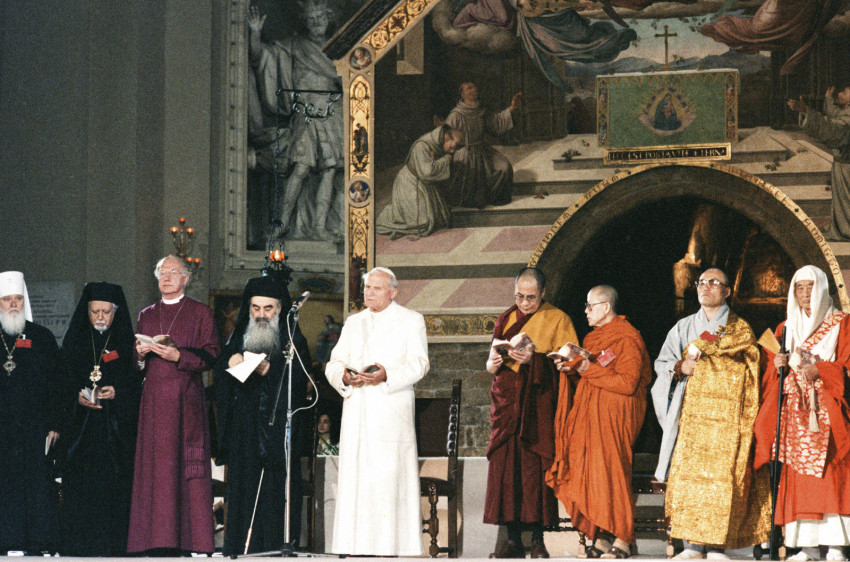
The next step of undoubted importance in the field of interreligious discourse was the ecumenical inter-faith gathering in Assisi convened by Pope John Paul II in October 1986, which was attended by a number of key religious leaders from around the world. One of the highlights of the event was when delegates listened together to the prayers for peace of the various faiths at the Santa Maria degli Angeli e dei Martiri Basilica. According to one of the bishops attending the event: “due to the cold, it was as if everyone drifted closer to one another”. Another key event on this occasion was when young Jews offered olive branches to Muslims standing on a platform. Subsequently, the event was commemorated in the form of an annual day of prayer. The significance of interreligious discourse is clearly shown by the fact that in his year-end speech of 1986, Pope John Paul II greatly lauded the importance of the interreligious meeting in Assisi. Thanks to Pope Benedict XVI, the gathering reconvened in Assisi on the 25th anniversary in 2011.
Other significant efforts included the meetings organised by the Community of Sant’Egidio for promoting interreligious and intercultural dialogue. The event launched in Rome in 2013 was attended by 400 religious and political leaders. Referencing the new generation engaged in interreligious dialogue, people frequently use the expression “People of Assisi” which was first coined by Andrea Riccardi. Another important event in terms of dialogue is the interreligious congress hosted in Kazakhstan since 2003. The 7th Congress of Leaders of World and Traditional Religions was recently convened in the presence of Pope Francis in September 2022.
A small, yet perhaps still important step in interreligious dialogue is the series of interfaith roundtable discussions hosted at the Napfényes Events Hall in Budapest that began upon the launch of Vol. II of The Torchbearers of Humanity religious encyclopaedia in Budapest, where the representatives of six world religions discuss the most important issues of life in a loving and accepting atmosphere.
We hope that these multiple initiatives which were previously separated in time and space will soon come together in the world and receive greater publicity. The ecumenical movement within Christianity will once certainly grow into an interreligious dialogue of all faiths.
On the importance of dealing with the lives of saints and their message
Familiarizing the lives and teachings of the great torchbearers of humanity provides answers to a number of pressing questions. Not only can this help us identify the most important, timeless values of life, but also by studying their lives, we can find a form of support and guidance that can help us overcome the difficulties of our lives by properly comprehending their message.
The torchbearers shine a light on the way ahead of us. As mankind often stumbles about in the dark, following the torchbearers’ light can help us familiarize, understand and transform the previously unresolved aspects of our lives. What is truly exceptional about these lives is that their teachings do not merely convey catchy, yet hollow knowledge, but rather their actions and lives lend credibility to their words. Their teachings are always based on their life experiences and actions, while their words of love and morality are authenticated by their sacrifices for the benefit of others.
The great torchbearers of humanity can be compared to well-to-do people who always pay the bills of others. Their sufferings offered up for others, strict fasting and prayers all serve the purpose of easing the pain and suffering of others. There are many who their lives by paying no heed to the future and thus accumulate “unpaid bills”. When these deeds become their fate, manifested in the form of diseases and unbearable suffering, these helpers come to our aid to bear the weight of our agony and pain, repenting and praying to ease our heavy burdens. These sacrifices are rendered quietly, in the background and modern man often fails to notice this at all, ignorant of the source of their aid. Naturally, the example set by the torchbearers and the practice of unseen good deeds originates from the heavens, from the angelic hierarchies who have been silently and invisibly assisting humanity for eons. They are imperceptibly holding our hands and guiding us as we blindly stumble about. The heavens set us the example of humble, unseen service and the utmost humility, while the torchbearers, the great helpers of humanity perform their services in a similar fashion.
Their exemplary lives try guiding us towards reducing the distance between people. One of the goals of religious tolerance is for us to get to know and understand each other and through this understanding to accept and love one another. One of the most gruelling tasks of the torchbearers of humanity is to bring the hearts of mankind closer to one another. Our hearts melt and open through the divine love emanating from them. Therefore it is always a wonderful and uplifting experience to be in their presence. Even reading the passages of disciples writing about the encounters with their master is enough to provide us with a powerful, lasting experience. That is why Vol. III of The Torchbearers of Humanity religious encyclopaedia includes a selection of writings from disciples and well-known authors sharing their thoughts about a number of deeply respected and venerated masters and saints.
In conclusion, let us add that studying the lives of saints and masters can be incorporated into spiritual practices. We can all draw strength from the messages of their lives. Some saints help us develop the virtue of humility, whilst others set an example of perseverance, patience or simplicity, and so on.
Let us never forget that we can also turn to the great torchbearers for help! If our request is in line with the laws of the cosmos and serves our approach to God, as humble heavenly servants they can intercede on our behalf, allowing us to become better, more virtuous people.
dr. Atilla Torgyán

