
Saint George
around 270 CE, present-day Turkey–around 303, present-day Israel
Saint George, a prominent figure of Christianity and certainly one of the most important saints in terms of his influence, was born in Cappadocia around 270 AD. He is best known as the knight who slayed the dragon, and is one of the most famous soldier saints and one of the fourteen saints who are called upon to intercede for various ailments. He was considered one of the seven great champions of Christianity (including the patron saints of seven nations: Saint Andrew of Scotland, Saint Patrick of Ireland, Saint David of Wales, Saint Denis of Paris in France, Saint James of Spain, Saint Anthony of Padua in Italy, and Saint George of England).
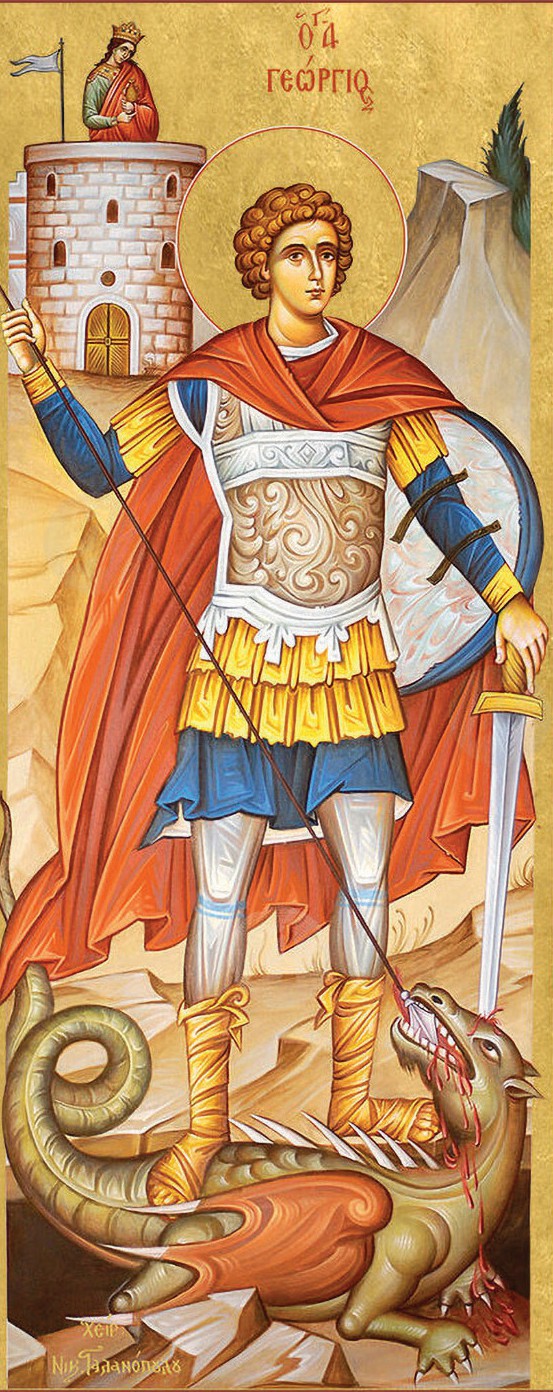
There are many theories about his origins and a great deal of contradictions concerning his biographical details. According to his most commonly accepted biography, his father died a heroic death as a Roman soldier and his mother raised him alone. He embraced the teachings of Jesus Christ at a very young age and with exceptional ease, and also became skilled in horseback riding and the use of weapons. His gait and movements were described as emanating great power to those around him. He loved adventure, and his mother encouraged him in this pursuit, believing that ‘idleness is the devil’s pillow’. George was baptised at the request of his deeply religious mother and chose a military career out of respect for his father.
In the Roman army, he quickly rose to the rank of tribune, or colonel, thanks to his fine swordsmanship. Despite his youth, he is said to have commanded a host of five thousand men, the size of a legion at the time. Even as a Roman soldier, George lived a Christian life during the bloodiest Christian persecutions. Eventually he was martyred, openly professing his faith throughout his suffering. According to one version of his ordeals, he was persecuted by the pagan Persian King Dadianus, yet later versions mention the Emperor Diocletian, who was initially generous to Christians but later called for their persecution. The emperor devised various tortures for George to persuade him to renounce his faith. Among other things, he had him crippled onto a wheel, poisoned and thrown into a vat of molten tin, but George miraculously emerged unscathed. As a prisoner, Jesus Christ himself appeared to him and told him that his sufferings would last for seven years, after which he would die and rise again three times. Finally, after the prophecy had been fulfilled, the emperor had him beheaded seven years later.
The legend of George includes a number of peculiar stories. Seeing his miracles, the head of the executioners, Anatolius, was converted along with all his soldiers, for which they were beheaded. Legend has it that at the request of Tranquillinus, he resurrected seventeen men who had died 460 years before his time and who, after being baptised, disappeared. In other tales, he is said to have demolished idols in pagan temples with his breath. Empress Alexandra converted in light of George’s torture and his brave undertaking of it, his repeated deaths and resurrections. 795 years after his death, he appeared as a standard-bearing knight at the Battle of Antioch (1098) to lead the Frankish forces to victory at the head of the Crusades.
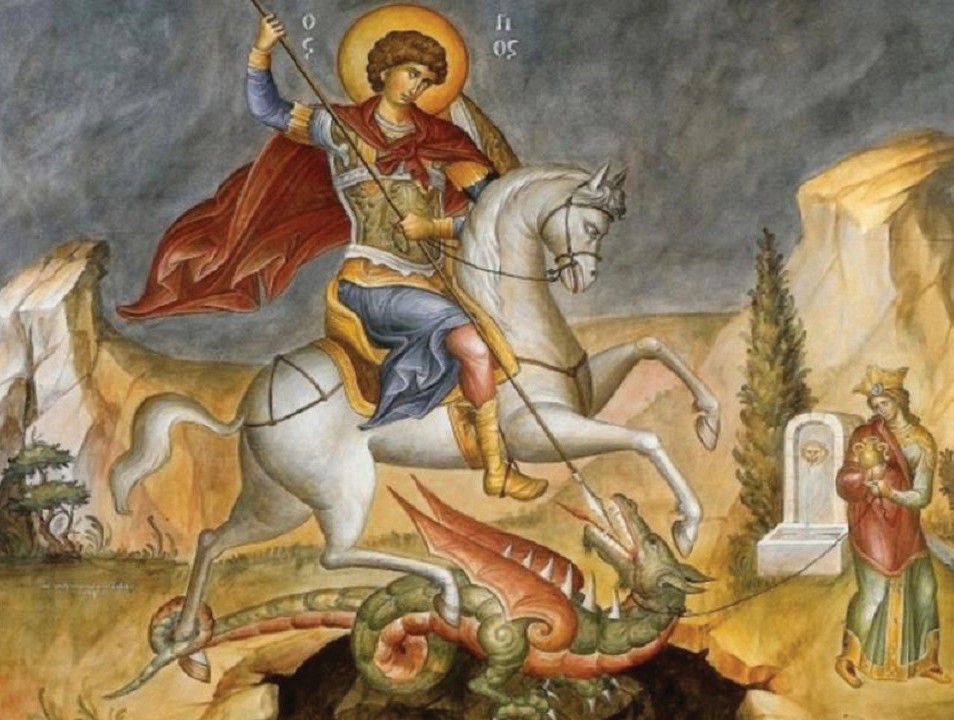
Yet the most memorable legend of Saint George is of how he defeated the dragon in the lake near the town of Sylena (the present-day Cyrene in Libya) in the name of Jesus Christ and rescued Princess Margaret. An important motif in the story is George’s appeal to the people of the king and the city: ‘Place your faith in Christ and be baptised, and I will slay the dragon!’ This legend, according to some scholars, is more symbolic in nature, capturing man’s inner turmoil against the evil within him. However, the legend also refers to the relationship between Saint George and Saint Michael, as Saint Michael also fought the dragon, the embodiment of evil. In some teachings, Saint George is presented as the earthly representative of Archangel Saint Michael, who helps all people in the most important battle of their lives between good and evil, in which good eventually triumphs. The importance of Saint George is also emphasised by esoteric Christian scholars who recognise his ties to Michael, the leader of the angelic orders, who is considered the spiritual leader of our time.
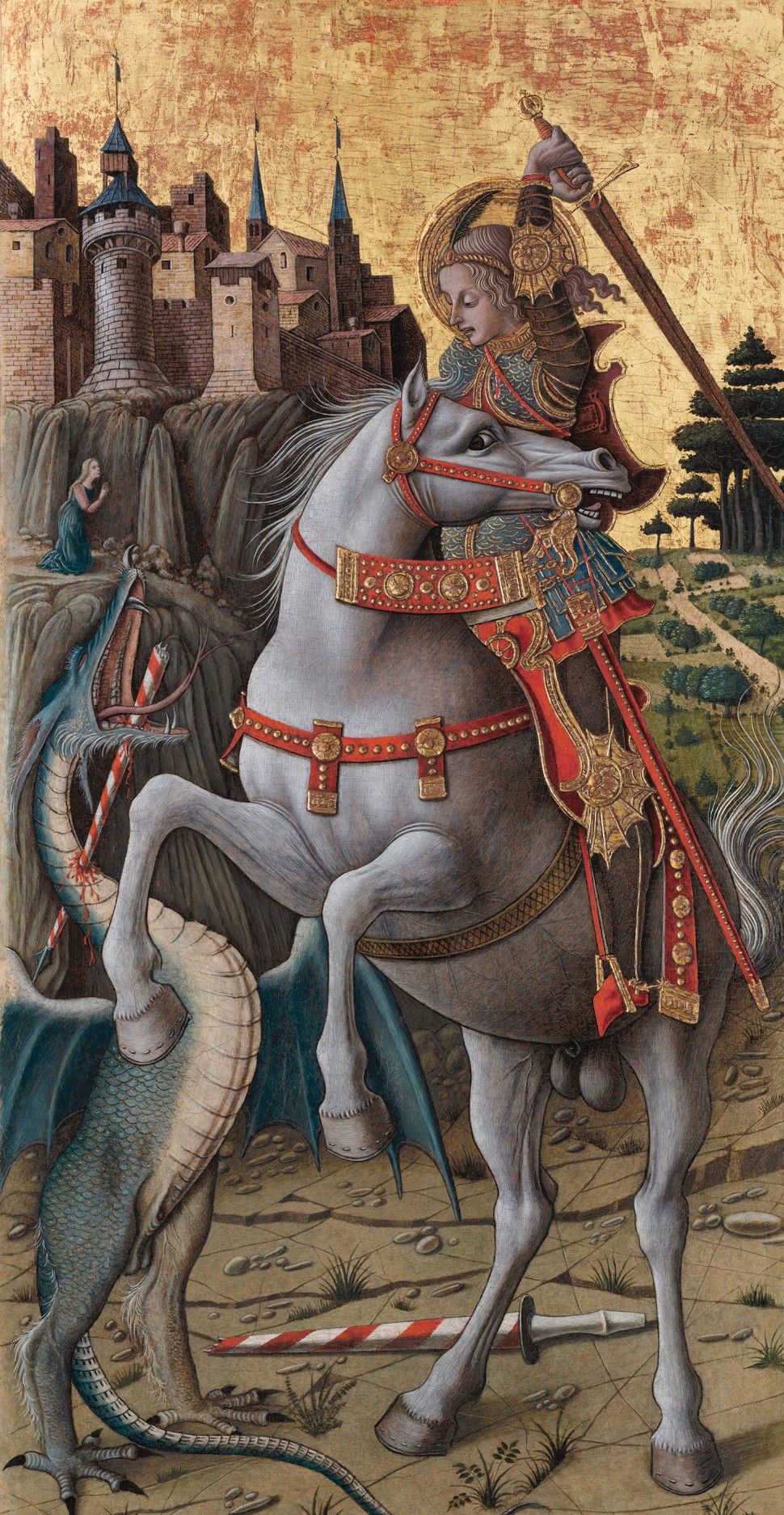
The veneration of Saint George was most prominent in the age of chivalry. Crusaders returning from the Holy Land spread the news of the saint throughout Europe and the British Isles. He was chosen as the patron saint of several knight’s orders. Over the centuries, Saint George has become the patron saint of the halberdiers, armourers, knights, horses, soldiers, scouts, lepers, peasants, husbands, and the patron saint of England, Portugal, Greece, Lithuania, Serbia, Moscow, Barcelona, London, Istanbul, among others. Richard the Lionhearted chose him as his patron saint. He was also commemorated in the battle cry of the English soldiers: ‘God for Harry, England and St George!’
In the words of Pope Gelasius, George was among those saints “whose names are justly reverenced among men, but whose actions are known only to God.”
“God, the Father of our Lord Jesus Christ, we call upon Thy holy name and humbly implore Thy clemency, that by the intercession of Mary, ever Virgin Immaculate and our Mother, and of the glorious Archangel St Michael, Thou wouldst deign to help us against Satan and all other unclean spirits who wander about the world for the injury of the human race and the ruin of souls.”
(Catholic prayer for the protection of Saint Michael)
“Michael! Exalted, powerful Prince of the Heavens! Who carriest aloft one golden shimmer Of Christ, the King, Holy is thy name, O Michael, Who art like unto God. As companion of the Thrones Thou art the foundation stone Of the Heavenly Firmament. Thou standest in the castle of the Kyriotetes and risest high amongst the Dynameis. Amidst the Exusiai and Archai As a radiant light thou appearest. Into the Cherubim’s sacred chorus the cleansing fire thou carriest. By thy holy spear supported, Over the Seraphim thou rulest. Thou, as the eldest, art the rightful leader of all the hosts of Heaven…”
(excerpt from a 13th century esoteric hymn to Saint Michael)



