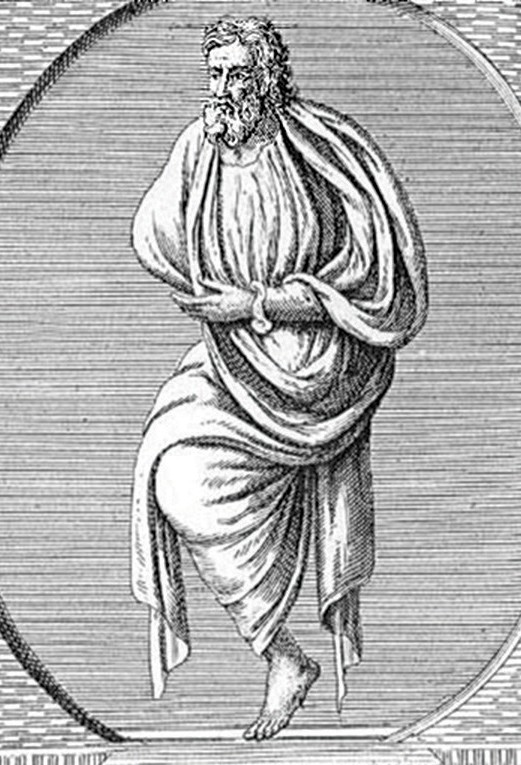
Pherecydes of Syros
580 – 520 BCE, present-day Greece
Pherecydes of Syros, the great Greek thinker whose teachings served as the basis for the concepts of the philosophers Heraclitus and Plato, lived in the mid-6th century BCE, the heyday of Greek intellectual development, as a contemporary of Thales and Anaximenes. Little is known of his life, yet his work is of great significance. He was a disciple of Pittacus, one of the seven Greek sages, and like all the great masters of his time, he was initiated in various mysteries. He resided in Egypt for ten years, where he received initiations, and thus acquired a vast body of knowledge.
His teachings represent a blend of the traditions of various former cultures. When the time was right, he established a school on the island of Samos. According to Theopompus and Cicero, Pherecydes was one of the first to write in Greek language, in prose form, about nature, the origins of the world and the gods. Aristotle, on the other hand, regarded him more as a theologian who avoided overly mythical descriptions and magically blended science with poetry in his depictions. Pherecydes believed in the immortality of the soul and, together with Thales, taught metempsychosis, or the transmigration of the soul.
He rejected the theory of primordial chaos and held that there are eternal (never born and never ceasing) forces behind the creation of the world. According to his theories, we must see the work of Chronos, the lord of time in the phenomena of the visible world, Zeus in the animating ether, and Chthon in the earth. According to some accounts, he even saw how the airy, fiery and watery elements are born from Chonos and then materialised with the help of Chthon and Zeus. The work of Pherecydes cannot be considered pure philosophy as his teachings form a bridge between the world of myth and philosophical thinking. He was considered one of the most important and original thinkers of his time, as the founder of the third school of theological philosophy, alongside the social philosophy of Solon and the natural philosophical approaches of Thales of Miletus.
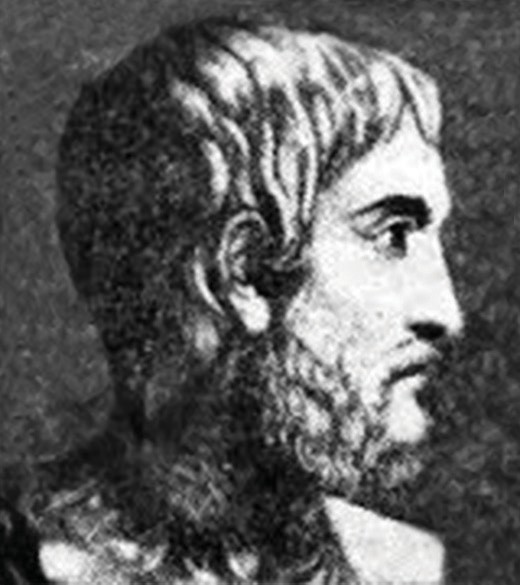
In addition to his work on the creation of the world, he wrote about the sevenfold division of the universe. The elements of the universe included infinite space, the world of stationary stars and wandering stars (planets), the spheres of the Sun, Moon and Earth, and finally the underworld. (This division was later adopted by many other thinkers.) There are many legends about the philosopher’s unique powers. He predicted, for example, the sinking of a ship and the fall of the city of Messenia. There are various stories about his unfortunate death, which he also foretold. Some say he died in Delos, and was cared for in his final days by his disciple Pythagoras.
However, other sources indicate that he wished to die in Manisa. Indeed, at the time of his death the city of Ephesus was at war with a rival, and Pherecydes, hoping for the Ephesians to be victorious, ordered to be taken to Manisa in the land of their enemies, and buried there after his death, as this would help the victory of the holy city of Ephesus. He alone knew that this was God’s decree. After his death, his teachings were revived in the school of his chief disciple Pythagoras. A contemporary author wrote the following about the master of Syros: “He lived with courage and modesty; and now that he is gone, he lives on in peace …”
“Aristotle considered Pherecydes of Syros one of the theologians who avoided overly mythical descriptions, magically blending science with poetry in their depictions.”
“All that we see in the world is based on three principles, the originator of the world: Chronos, Zeus and Chtonie. Chronos gives birth to the air, fire and water, which are opposed by Ophioneus, the serpent.”
“The immortality of the soul is mentioned in countless writings of the past centuries, but Pherecydes of Syros was the first to establish the doctrine of the immortality of the soul.” (Cicero)
“Pherecydes says that when Zeus created the world (…) he wove the Cosmos together from the various elements in harmony and love, and implanted in everything unity and the aspiration to love.” (Proclus)
The following was written of the Master of Syros: “Adorned with valour while alive, and modesty. Now that he is dead, he still exists in peace.”