Subhuti
6th century BCE, India
According to early Buddhist traditions, Subhuti was one of the ten great disciples of Gautama Buddha and was the first to understand the essence of the phenomena and the doctrine revealed by the Buddha. Subhuti had an exceptionally profound relationship with the Buddha, who truly showered him with gifts and attention. There are not many stories about him, yet he was present at countless important teachings and his name is often mentioned in the fundamental writings of Mahayana Buddhism. These teachings, unlike the Hinayana, made Buddhist doctrine accessible to a wider range of disciples, and its principles were easier to follow, even for lay people and families. It is said that Subhuti’s name is mentioned so frequently in the Prajnaparamita Sutra because understanding these teachings of perfect wisdom required ‘direct vision of emptiness and openness’ that is, Subhuti’s humble attitude of self-surrender rooted in the heart. The literal meaning of his name is ‘worthy of gifts’ and ‘living remote and in peace’.
He was born in Savatthi in a Brahmin family. It is said that at the birth of Subhuti, the furniture and other furnishings of their house miraculously disappeared. According to a tale that captures the essence of Subhuti’s attitude, one day when Subhuti was weaving the fabric for his monastic robe, the Buddha returned from one of the celestial realms. The disciples rushed to greet him, and when Subhuti was informed of his return, at first he also stopped his work and went to greet the Buddha. Yet on his way to greet him, he realized that the Buddha’s true appearance could not be seen with ordinary eyes. What we perceive is only a play of the elements, and as such is transient. Yet Buddha himself is ultimately permanent, thus we can see him anywhere with our inner eye. So he went back and calmly continued weaving. A nun was the first to approach the master, and she expressed her joy at being the first to greet the Exalted One, yet in return she was told that although he could not see him with human eyes, Subhuti was the first to greet him, realising the hollowness of his teacher’s earthly appearance.
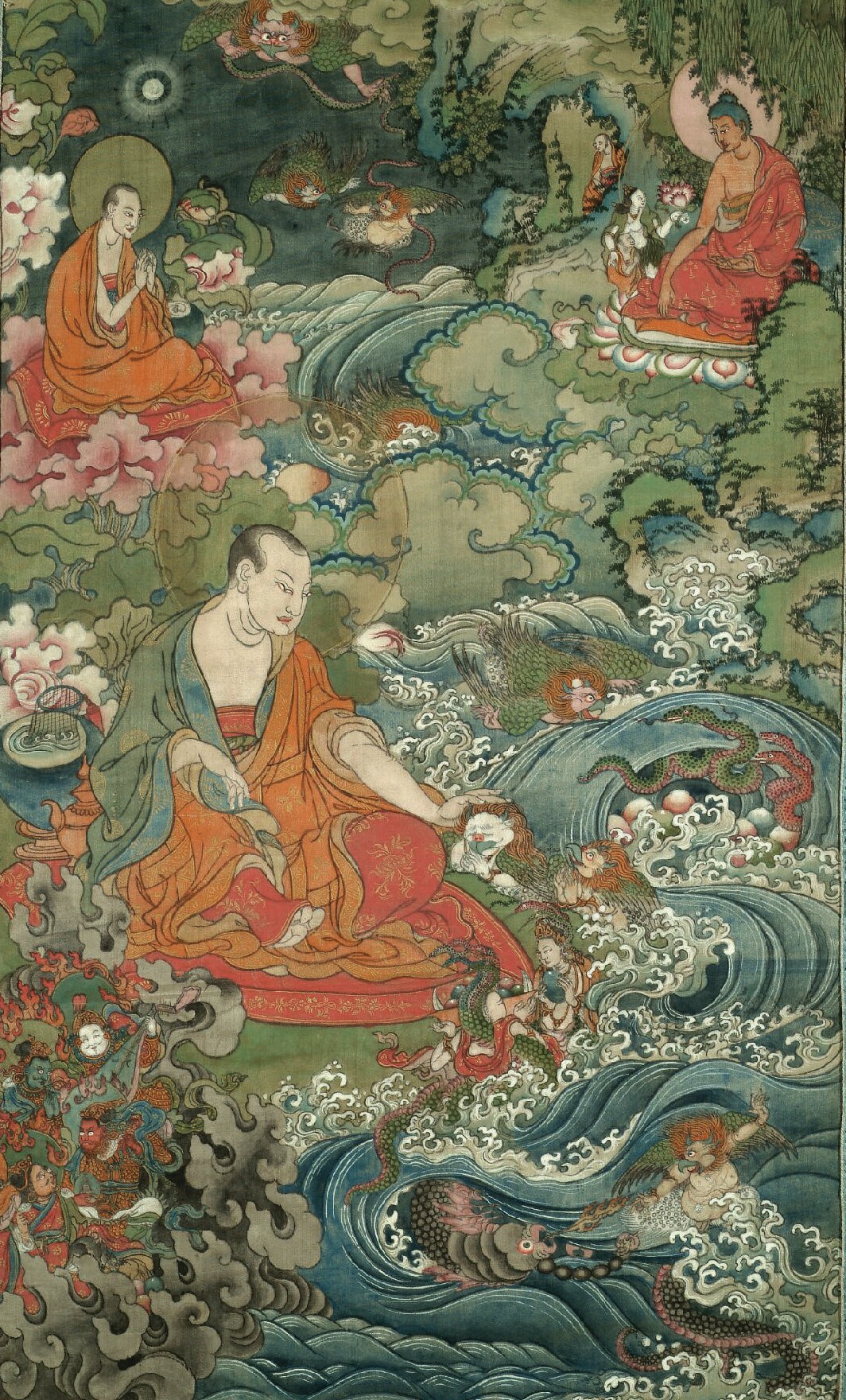
He was once meditating on Vulture Peak when he unexpectedly fell ill. It is said that he did not search for physical remedies, but rather began to search for the deeper cause of his illness within himself. He thought that his condition might be the result of his past actions, and that therefore there was probably no cure for the disease, and that it would only disappear if, in his current life, he confronted all his mistakes and vowed never to make them again, and then worked ceaselessly to calm his mind. As soon as he considered this, his illness was cured just as suddenly as it had appeared. This story is an important precursor to the modern scientific approach of healing based on man’s self-awareness.
Buddhist monks were not allowed to be choosy about the donations they received and were not allowed to see whether the food was given by the rich or the poor. Yet Subhuti spared no effort in always seeking out rich people and took care not to ask the poor for alms. It is believed that of the teachings of Mahayana Buddhism conveyed to the wider public, the Enlightened One taught the Diamond Sutra specifically to Subhuti. In fact, in the sixth chapter of the Lotus Sutra, he even predicted to him when and how Subhuti would attain full enlightenment. In Tibet, the lineage of the Panchen Lamas is traced back to Subhuti. In Chinese literature he appears as the teacher of the Monkey King, Sun Wukong, and it is easy to recognise in their figures the two famous Chan (Zen) masters, the sixth patriarch Huineng and his master Hongren. It is also important to mention the Buddhist tale according to which the Buddha once travelled in secret to China in 564 BCE in the company of Subhuti. It is here that Buddha is said to have had a special encounter with the Taoist master Laozi. According to the story, the Buddha asked him to teach Subhuti, so Laozi imparted to him – amongst other things – the secret of immortality, or how to retain the youthfulness of the body with the replenishment of etheric life forces. Some believe that Subhuti is one of the famous immortals mentioned in many writings: he is said to be alive today at two thousand six hundred years of age without his body showing any signs of aging.
“By the force of this dharma, the venerable Subhuti was moved to tears. Wiping his eyes, he said to the Buddha, “How remarkable, Bhagavan, how most remarkable, Sugata, is this dharma teaching that the Bhagavan speaks for the benefit of those beings who seek the foremost of paths, for the benefit of those who seek the best of paths, and from which my own awareness is born. Bhagavan, I have never heard such a teaching as this! They shall be the most remarkably blessed of bodhisattvas, Bhagavan, who hear what is said in this sutra and give birth to a perception of its truth. And how so? Bhagavan, a perception of its truth is no perception of its truth. Thus does the Tathagata speak of a perception of its truth as a ‘perception of its truth.’”
“Hearing such a dharma teaching as this, Bhagavan, it is not remarkable that I should trust and believe it. But in the future, Bhagavan, in the final epoch, in the final period, in the final five hundred years of the dharma-ending age, Bhagavan, those beings who grasp this dharma teaching and memorize it, recite it, master it, and explain it in detail to others, they shall be most remarkably blessed. Moreover, Bhagavan, they shall not create the perception of a self, nor shall they create the perception of a being, the perception of a life, or the perception of a soul. They shall create neither a perception nor no perception. And why not? Bhagavan, the perception of a self is no perception, and the perception of a being, a life, or a soul is also no perception. And why not? Because buddhas and bhagavans are free of all perceptions.”
This having been said, the Buddha told the venerable Subhuti, “So it is, Subhuti. So it is. Those beings shall be most remarkably blessed, Subhuti, who are not alarmed, not frightened, and not distressed by what is said in this sutra.” (excerpt from the Diamond Sutra)