Francis de Sales
1567–1622, present-day France
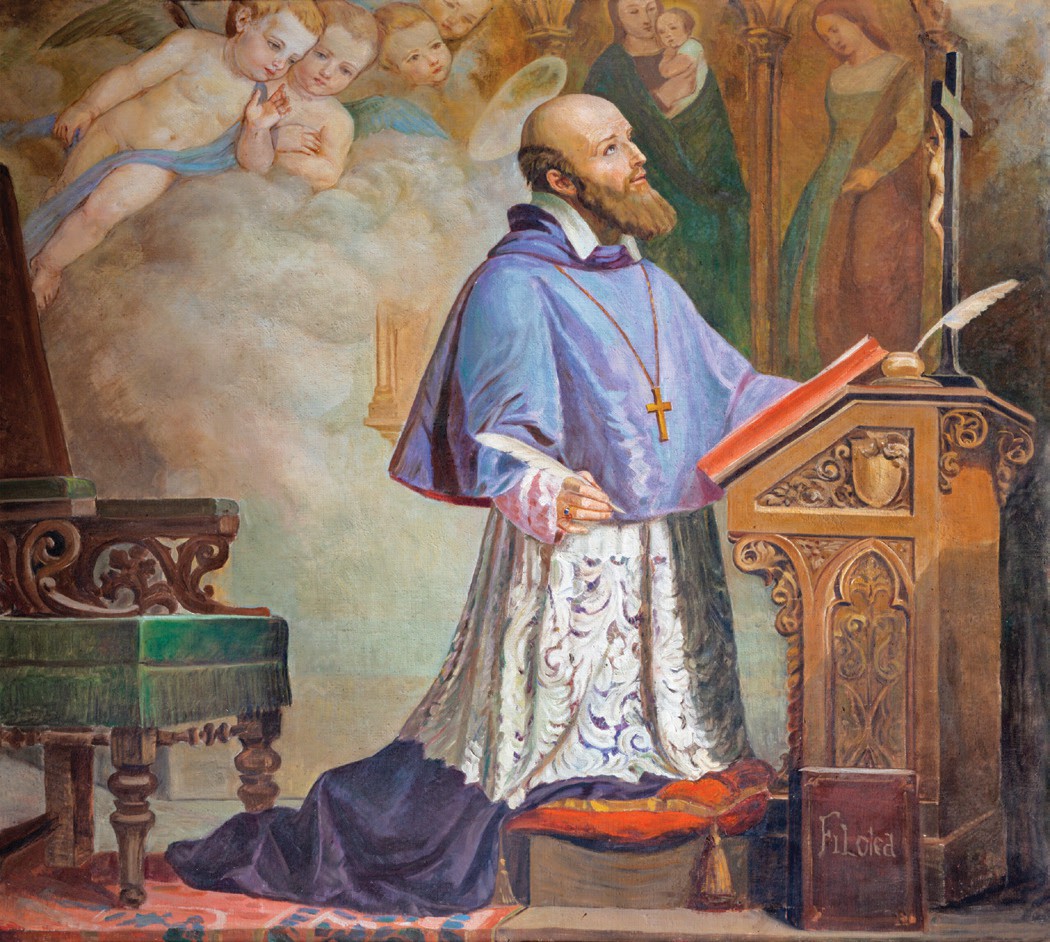
Francis de Sales, the saint of Savoy, the most influential Catholic monk in France, was born in Sales, the first child of an ancient noble family. Destined by his father for a career in law, he was sent at an early age to the Jesuit College in Paris, where Francis also attended theological lectures of his own volition. He was despaired by the Calvinist doctrine of ‘predestination’, according to which God has preordained who would be saved and who would be doomed to damnation before the creation of the world. He was convinced that he himself would go to hell. Nevertheless, praying before the image of Our Lady, he chose God’s love, a decision that immediately freed him from his nagging doubts.
He began his legal studies in Padua, where he studied the works of St Augustine, St Ignatius of Loyola and St Thomas Aquinas, under the influence of his spiritual mentor, a Jesuit monk. After completing his legal studies, Francis’ father did not agree to his son becoming a priest, yet at the intercession of his uncle, a canon, the Bishop of Geneva appointed him Provost of the cathedral chapter of Geneva. His father accepted the bishop’s decision and Francis was ordained a priest in December 1593. He spent the first year of his priestly vocation in the Chablais region, where he had previously converted the inhabitants to Calvinism.
At first, no one heeded Francis and he was chased from their homes, but despite the unfriendly reception, he did not waver: he spent long periods of time saying mass in empty churches, and recording his reflections, in which he expounded the central truths of the Catholic faith, and posted them in public places and slipped them under doors. In Francis’ time, this was an unprecedented method, and one of the reasons why he later became the patron saint of journalists. He summarised these writings in so-called pamphlets. As a result of his persistent efforts, by 1598 a large part of the population of the province of Chablais had converted to Catholicism. After a year, the Pope appointed him coadjutor bishop of Geneva, and then bishop in 1602, after which he immediately set about reorganising the life of the diocese.
He maintained close contact with the people, helped them without discrimination, and was a dutiful and committed leader to them. He laboured to instil in his Catholic brethren the faith and piety he had come to know through the Reformist believers. To this end, he wrote countless letters. One of his most widely read works, on living a virtuous life based on Christian values, was published in 1608 entitled Introduction to the Devout Life. He had an intimate spiritual relationship with Joan Francisca de Chantal. Their relationship was the result of heavenly will: each had an important vision in which the other appeared. Their initial encounter was the beginning of a lengthy correspondence and an intimate relationship, an important example of the spiritual bond between two people that transcended all sensuality.
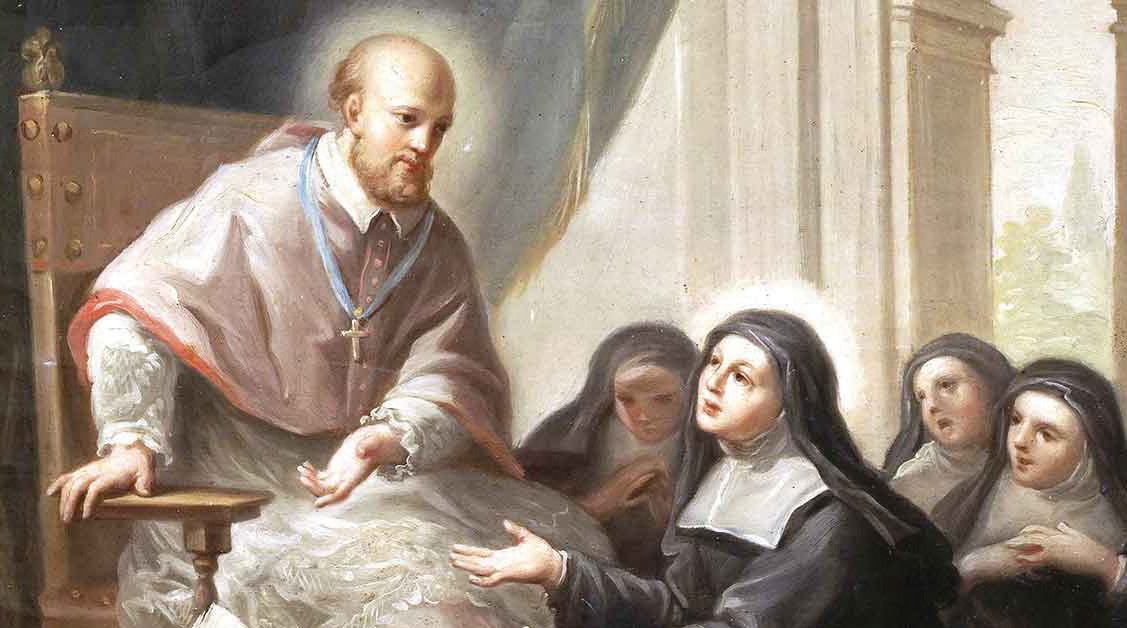
Francis outlined to her before anyone else his plans to found a convent of women, which they would later establish together in 1610, where they would receive elderly and sick sisters and devote themselves to the practice of charity. Subsequently, under the leadership of Joan Francisca de Chantal, a community of Visitation nuns was established, based on the pillars of work and contemplation. The order established 12 convents during Francis’ lifetime and later spread throughout the world. In the final years of his life, Francis was wholeheartedly devoted to Christian mysticism. He summarised his teachings in his Treatise on the Love of God. He was enormously popular and many disciples gathered around him.
Nevertheless, in his final years, he led an increasingly ascetic, reclusive life. In 1622, he accompanied the Duke of Savoy to Avignon, with a foreboding of his imminent death, and on his way home he stopped in Lyon, in the small, modest house of a visitation monastery gardener. He still had the fortune to have a brief meeting with Joan Francisca de Chantal for a few hours before suffering a stroke on 27 December, which led to his death a day later. He was beatified in 1661 and canonised in 1665. Don Bosco founded the Salesians in 1854 in memory of St Francis of Sales. He chose as the motto of the Order a thought from St. Francis: “Give me souls and take all the rest!”
“The world, looking on, sees that devout persons fast, watch and pray, endure injury patiently, minister to the sick and poor, restrain their temper, check and subdue their passions, deny themselves in all sensual indulgence, and do many other things which in themselves are hard and difficult. But the world sees nothing of that inward, heartfelt devotion which makes all these actions pleasant and easy.”
“Nothing is so strong as gentleness, nothing so gentle as real strength.”
“Never be in a hurry; do everything quietly and in a calm spirit. Do not lose your inner peace for anything whatsoever, even if your whole world seems upset. What is anything in life compared to peace of soul?”
“A spoon full of honey gets more flies than a barrel full of vinegar.”
“We believe that we become more and more like Jesus Whom we receive in Holy Communion. Nothing so inflames the human heart as this act of self-emptying love.”
“Have patience with all things, but chiefly have patience with yourself.”
“I said everything in just two words, when I told you to refuse nothing and to desire nothing; I have nothing more to say to you.”