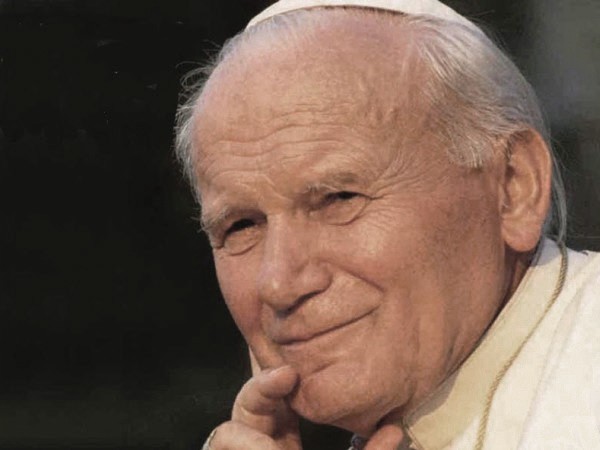
Pope John Paul II
1920, Poland – 2005, Italy
Pope John Paul II, the former head of the Catholic Church, was born on 18 May 1920 under the name of Karol Józef Wojtyła in Wadowice, Poland close to Krakow. He attended secondary school in Krakow, yet he was forced to interrupt his studies in 1939 when the occupying German forces closed the institution. Wojtyła first became a factory worker before going on to work in a quarry, while also showing interest in literature and philosophy, writing and directing plays. While continuously seeking meaning in life, he realized that instead of relying on force, he would resort to the power of the word, applying in 1942 to an illegal seminary school.
After being ordained in 1946, he passed his doctoral exam at the pontifical school in Rome. For a brief period, he was assigned as a rural assistant pastor before being transferred to the parish of Saint Florian in Krakow. As a pastor, he began organizing his church community with great enthusiasm and a number of new approaches. He gathered a number of young people and took them on trips and excursions. It was exemplary how he entirely devoted all his attention to others. His great wisdom and wide-ranging skills quickly attracted the attention of his superiors and he was first consecrated as bishop at a very young age in 1958, before being appointed Archbishop of Krakow, and cardinal in 1967.
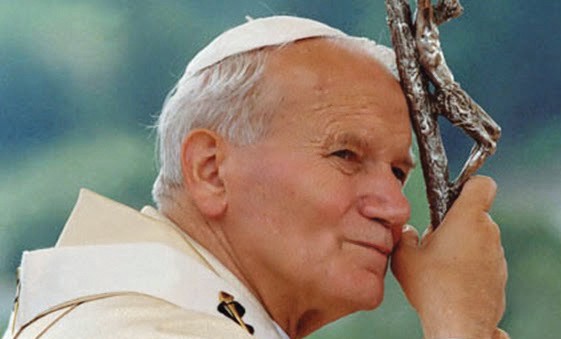
He was actively involved in the work of the Second Vatican Council, facilitating the reform of the Catholic Church. To widespread surprise, he was finally elected pope in 1978 – this was when he took the name of John Paul II – marking the beginning of one of the most important periods of church reform. He was the first pope from Eastern Europe in the history of the papacy. He never denied his Polish roots, the spirituality of his country and the veneration of the Virgin Mary. His hardship and the horrors of the Second World War made him sympathetic to human suffering. His great dream was the establishment of Christian unity. As a traveling pope, he visited 129 countries and continued to make visits even when sick and elderly. Wherever he went, he showed his support for the poor, giving them strength and courage and keeping them in his prayers. His open stand did much to bring forth the downfall of communism. He reformed the Canon Law of the Catholic Church and drafted the new Catechism of the Catholic Church.
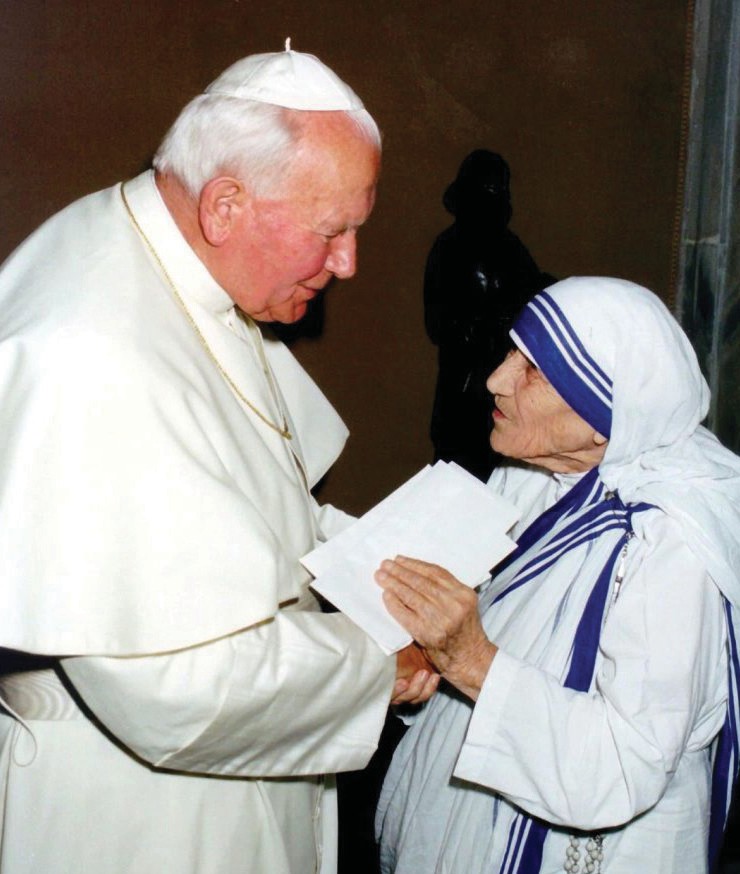
He wrote his own speeches and often spoke up for human rights and dignity. He also took great care to establish new forms and organizations: he initiated the annual Catholic World Youth Day events and invited the representatives of the various denominations to Assisi for universal prayer service. Paradoxically, although he showed kindness to everyone, they attempted to assassinate him on twenty different occasions as his reform efforts were considered a threat by various political and economic interests. The most widely known of these was the attack in 1981: a Turkish gunman shot the pope at point blank range and it is a miracle that he survived the attack at all. The pope later visited his attacker to talk to him and frequently prayed for him.
His health rapidly deteriorated after 1993 and the last twelve years of his life were a period of intense agony. He was diagnosed with Parkinson’s disease and he could barely talk and move towards the end of his life. Still, he relentlessly pursued his efforts. There was a sense that he was sharing the fate of others through the suffering he was voluntarily undertaking. His life is a fine example of how to remain humble in a leadership position. At a leper colony, he not only touched the disfigured, faceless people, but also caressed them, kissed them and fed them. He referred to himself as the „servant of the servants of God”, and indeed that was how he carried himself. Wherever he could, he stood up against tyranny and lies. He was also known for asking forgiveness for the church’s past sins. Whenever possible, he was engaged in prayer – often praying through the night.
As pope, his day started at 5:15 am and ended at 11:45 pm. He did not snack, or indulge in any pleasures. He drank no alcohol, ate simply and kept his comforts to a minimum. He fasted on Fridays, while continuing his intensive efforts. They said that when he was engaged in writing, he worked with such devotion that used up a pen almost every other day. A number of books and films were published on his life following his death in 2005. People loved him dearly, and they could sense from his personality, gestures and modesty that he lived an authentic life. At his funeral, the masses cried: “Santo subito!” calling for “sainthood now”. In response, the Church beatified him, shortly followed by his canonization.
“We need to find God, and he cannot be found in noise and restlessness. God is the friend of silence. See how nature – trees, flowers, grass – grows in silence; see the stars, the moon and the sun, how they move in silence… We need silence to be able to touch souls.”
“We think sometimes that poverty is only being hungry, naked and homeless. The poverty of being unwanted, unloved and uncared for is the greatest poverty. We must start in our own homes to remedy this kind of poverty.”
“I have found the paradox, that if you love until it hurts, there can be no more hurt, only more love.”
“The worst prison would be a closed heart.”
“I see God in every human being. When I wash lepers’ wounds, I feel I am nursing the Lord himself. Is it not a beautiful experience?”
“There is more hunger for love and appreciation in this world than for bread.”
“Do you forsake the idol of money, the lust for possessions, luxury, the easy acquisition of money? Do you forsake the temptation of power, the dominion over others? Would you rather pursue brotherly service, following Jesus? Do you say no to temptation? Do you forsake the idolatry of sex as mere pleasure-seeking that prevents you from following Christ in worshipping the cross? Do you forsake the idol that would vanquish love?
(excerpt from Pope John Paul II’s speech at the Catholic World Youth Day in Manila)