Gertrude The Great
1256–1301/1302, present-day Germany
Great Gertrude of Helfta, medieval mystical Benedictine nun, patron saint of the West Indies, also known as the “messenger of divine grace”, was born in Thuringia, on the day of the Epiphany in 1256. Alongside Hildegard von Bingen and Saint Mechtild of Hackeborn, Gertrude was one of the most important Benedictine mystics. Most probably raised as an orphan, she was introduced at the age of five to the Cistercian-founded yet Benedictine-ruled monastery school of Helfta, where she lived until her death. At the monastery, she found a mother figure in abbot Gertrude Hackeborn, the head of the convent.
Even as a little girl, Gertrude excelled from her peers with her enthusiasm, thirst for knowledge and extraordinary intellectual abilities, artistic flair and fine sensibilities. She used Latin to perfection in her writings and her education was unrivalled in her surroundings. At her own admission, ‘she did not wish to fall behind any man in erudition or knowledge’. Music was also of great significance for her and she attended the music school of St Mechtild of Hackeborn, with whom she later maintained a loving master-student relationship, and who remained her confidante and companion in her spiritual life, as she enjoyed similar graces as Gertrude. They wrote their works individually, helping each other, providing inspiration to one another and those in their surroundings with their works. Their life dedicated to God served as a guiding force and support for their fellow nuns.
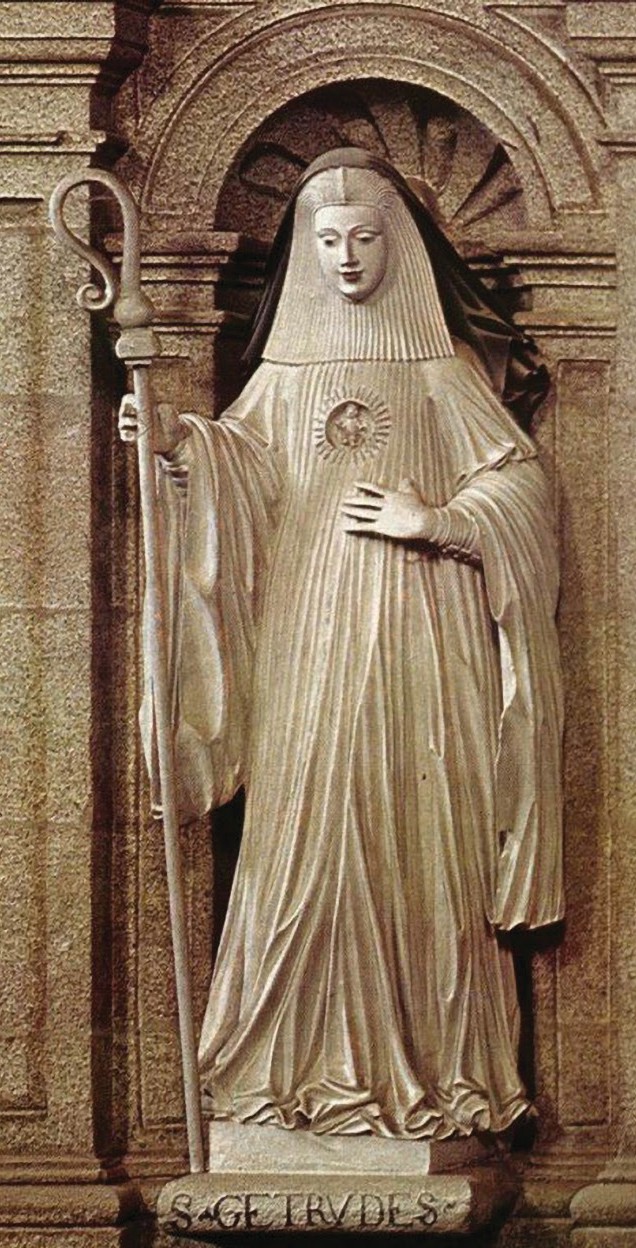
Gertrude studied the Scriptures in depth and translated them into German for her fellow nuns. After a long and arduous journey, at the age of 26, on 27 January 1281, Christ appeared to her and said to her: “I will save you, I will deliver you; fear not.” After this experience, Gertrude’s life drastically changed. In Christian mysticism, saints who are betrothed to their Master and who dedicate their lives to him are referred to as the “brides of Christ”. Gertrude was visited by the angels and saints as an ordinary person is visited by her acquaintances, and they spoke to her as close, dear friends. She felt she served as a channel through which God was pouring his grace into the world and into the people around her.
Yet despite the gifts God showered on her, Gertrude remained humble and modest throughout her life. She felt it was the greatest miracle that the “earth can bear such a worthless sinner as I am.” She was frequently ill and unable to write, yet despite her burdens and pains, she did not request any special attention or care, and continued to perform her religious duties. Gertrude’s true strength lay in her heart: she was courageous and freely followed the voice of love that flowed from within her. She wished to help everyone and pass on all the good she had received through the revelations.
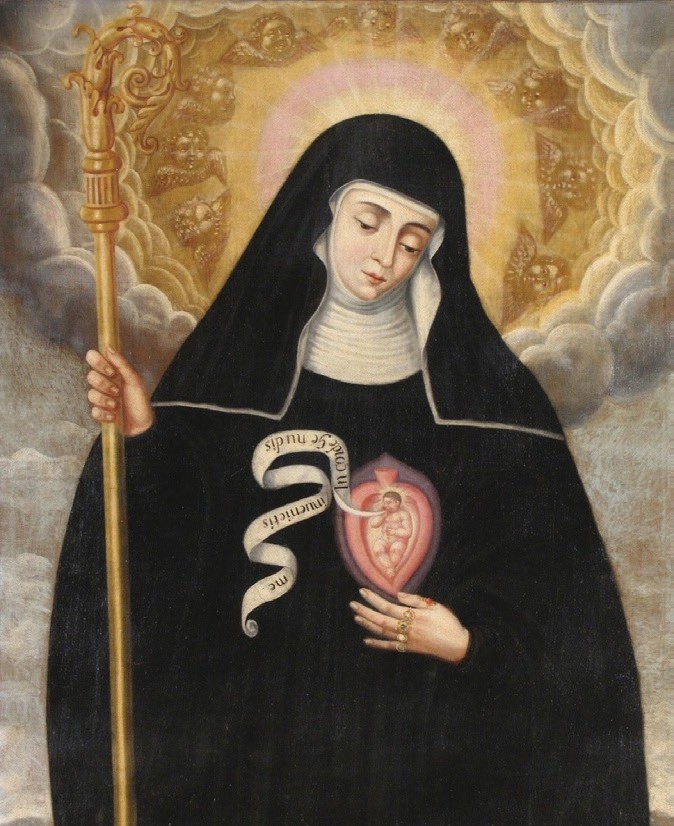
In Helfta, they strove to perform the Holy Mass and chant the hymns as perfectly as possible. For Gertrude, the liturgy was like the air that permeated everything. Nearly all of her visions and revelations were triggered by the various holidays, yet the visions also intensified the deeper understanding of these special days of the year. On the feast of St. John, the Apostle John once appeared to her and told her that at the Last Supper, when he laid his head on Christ’s chest, he could hear the beating of the Sacred Heart, the heartbeat of divine love. Gertrude is said to have borne the five wounds of Christ in her heart and also to have received seven gifts of grace from God, for which she wore seven rings on her fingers as symbols of these gifts. Through this intimate relationship with God, she gained insights into the mysteries of the Sacred Heart of God.
The details of her internal life were recorded in a five-part volume entitled Legatus Divinae Pietatis (The Herald of Divine Love). The majority of the work consists of passages written about people close to her and only the second book was written by Gertrude herself. The Herald related a series of miraculous tales in which Gertrude interceded to help the people around her. Her work entitled Spiritual Exercises is a beautiful hymn in which Gertrude prays to God. Gertrude knew the time of her death, which took place around the years 1301–1302, most probably on 17 November. Gertrude’s symbol is a radiant, flaming heart on the cross, which stands testimony to her inconceivably deep and varied inner life, devoted to helping others and bringing people closer to God.
“O Charity, O Love, at the hour of my death thou wilt sustain me with thy words, more gladdening far than choicest wine. Thou wilt then be my way, my unobstructed way that I may wander no more nor stray. Thou wilt aid me then, O love, thou queen of heaven; thou wilt clear my way before me to those fair and fertile pastures hidden in the divine wilderness, and my soul shall be inebriate with bliss; for there shall I see the face of the Lamb, my Spouse and my God.”
“My ministry,” answered the beloved Apostle, “in those early times of the Church was confined to speaking of the Divine Word, the eternal Son of the Father, some words of deep meaning upon which human intelligence might meditate forever, without ever exhausting their riches; but to these latter times was reserved the grace of hearing the eloquent voice of the Heart of Jesus. At this voice the time-worn world will renew its youth, be roused from its lethargy, and again be inflamed with the warmth of Divine love.”
(excerpt from the Revelations of Saint Gertrude)
“O most sweet Jesus! We beseech Thee, by the goodness which prompted Thee to give us so dear a mother, that, as Thou art about to take her from this world, Thou wouldst condescend to our prayers, and receive her with the same affection as Thou didst Thy Blessed Mother, when she went forth from the body!”
“I praise, adore, bless and thank you to the best of my ability for your wise mercy and your merciful wisdom! For you, my Creator and my Redeemer, have sought to curb my stiff-necked obstinacy under your sweet yoke with the remedy best suited to my infirmity.”