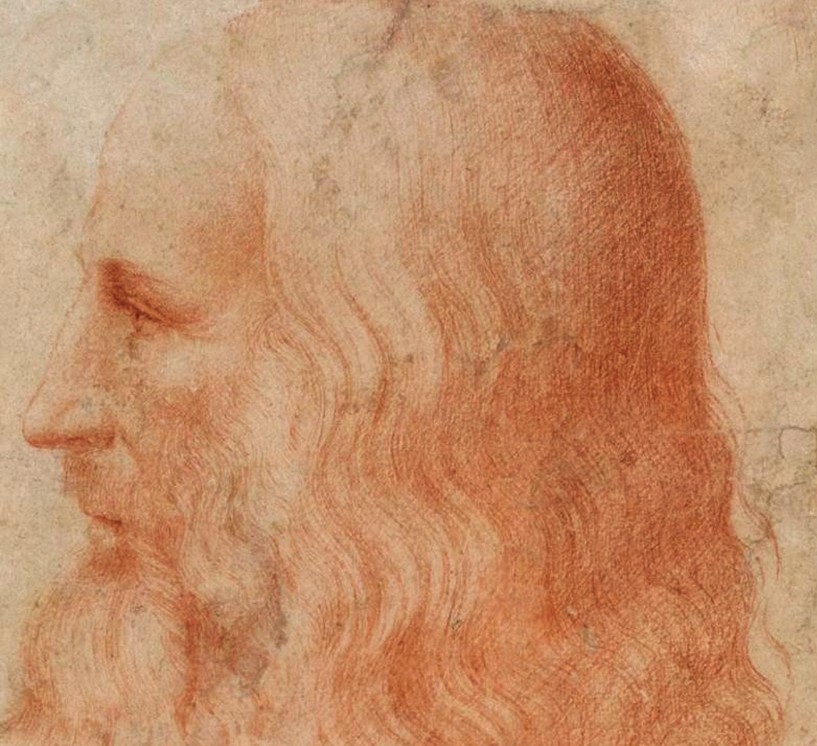
Leonardo da Vinci
1452, present-day Italy–1519, present-day France
“Love conquers everything.”
“As the likeness of God, man embodies the harmonies of the world on a small scale. A microcosm that encapsulates the macrocosmic totality.”
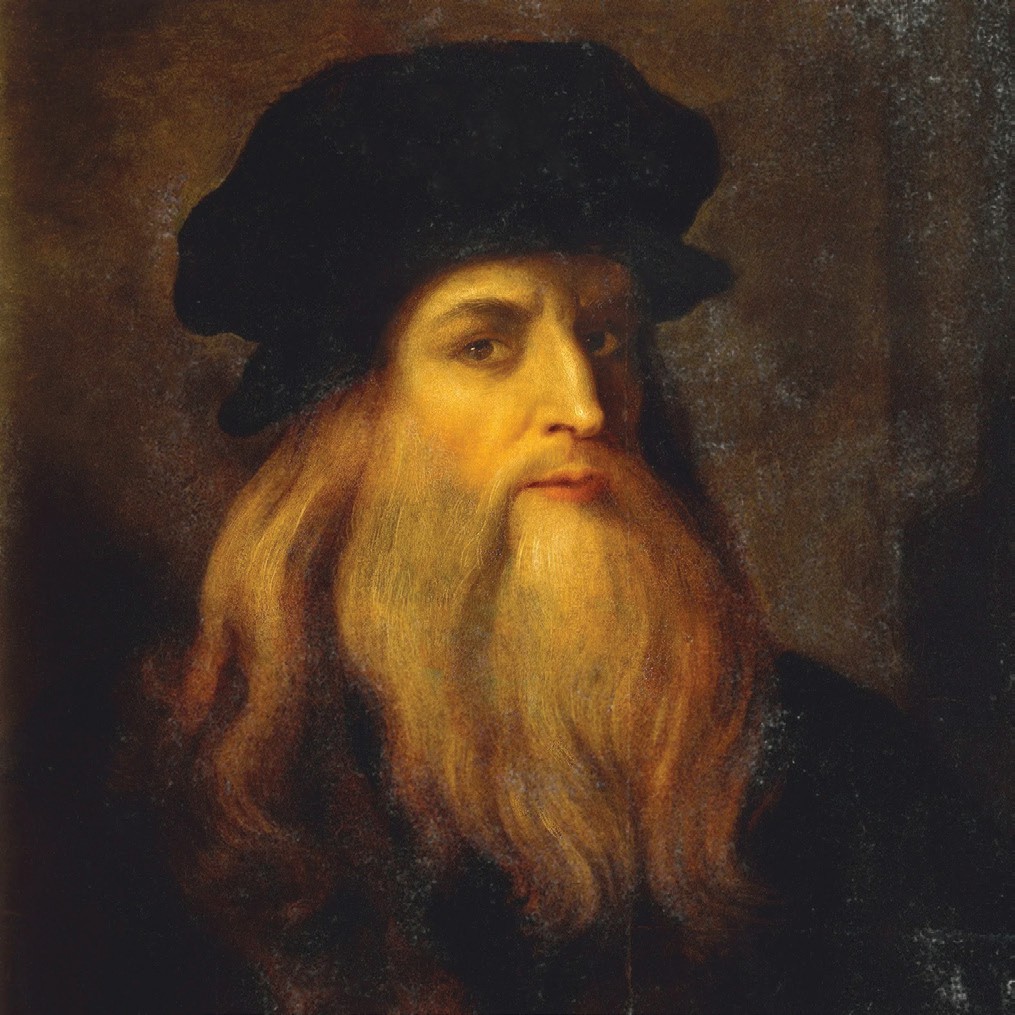
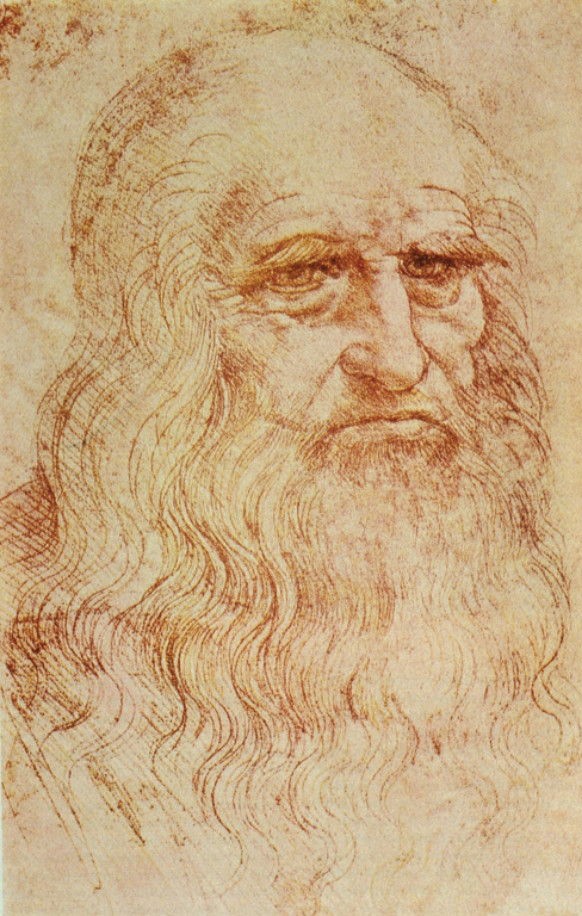
As the embodiment of the Renaissance humanist ideal, Leonardo da Vinci was a painter, scientist, inventor, sculptor, musician, botanist, anatomist, astrologer, architect, poet, writer and military engineer – in short, a true polymath who sought to understand and embrace the fullness and richness of life through his daily activities. He was born Leonardo di ser Piero da Vinci on 15 April 1452 in the town of Vinci located between Florence and Pisa, in the region of Tuscany as the illegitimate child of an affair of his nobleman father, the notary Messer Piero da Vinci.
Leonardo displayed exceptional talents at an early age, so in 1469 his father took him to the workshop of Donatello’s former pupil Andrea del Verrocchio, which was Florence’s most famous art school at the time. That is where he mastered the basics of painting, sculpture and metalsmithing. In his twenties, he joined the painters’ guild named after St Luke, who was also engaged in painting. His first independent work was the figure of an angel in the background of his master’s, Verrocchio’s painting The Baptism of Christ. Leonardo’s initial works quickly earned him attention and he received numerous commissions from the most prestigious clients.
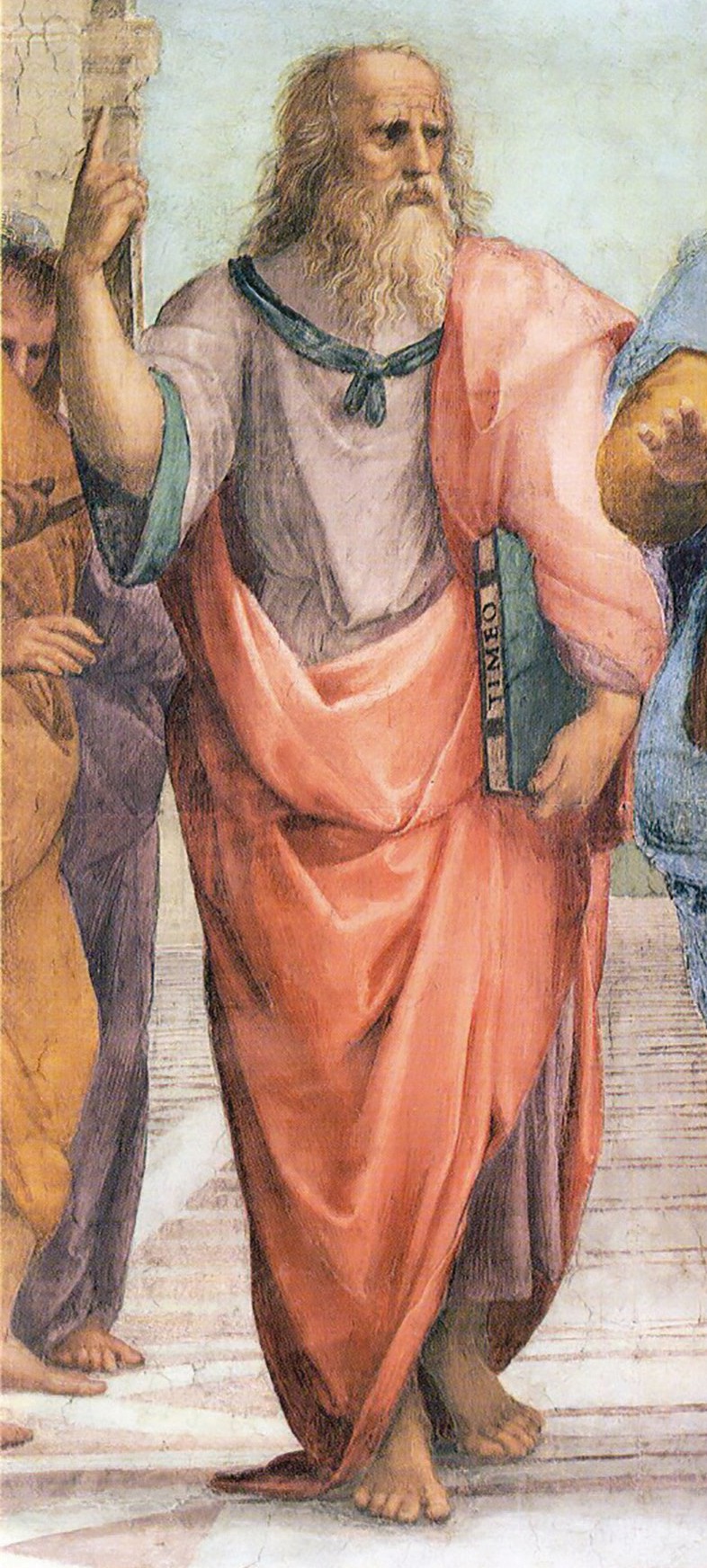
Legend has it that the young Leonardo’s talent even stunned his own master. According to Giorgio Vasari, the famous chronicler of the lives of Renaissance painters, “Andrea (Verrocchio) would never again touch colour, in disdain that a child should know more than he”. According to the records from the time, he disappeared for two whole years at the age of 24, yet when he returned, he formulated his ideas for tunnels, canals, military structures, planes, submarines and other structures that required technical knowledge far ahead of his time. Thanks to his unique wit, Leonardo was capable of combining science, religion and the arts in a way that perfectly complemented and transfused one another. He explored nature, watched people and studied the world with childlike curiosity – he longed to know all its visible, tangible and measurable, as well as its invisible, underlying truths.
As he put it, “Nature is full of infinite causes that have never occurred in experience.” He believed that a true painter should be a universal spirit who understands every detail of nature, as well as a scientist who knows objects as if he had created them on his own. His works the Mona Lisa and The Last Supper are considered amongst the most famous paintings of all time. He took the young genius, Raphael under his wing in 1503, just as he was beginning his work on the Mona Lisa. Many have tried to unravel the mysteries of this enigmatic painting. One view is that it is in fact a self-portrait with female features, which holds the secret of duality. We know from the studies on his life that he spent two whole years perfecting her smile.
Da Vinci kept this work as well as his painting of John the Baptist with him throughout his life, wherever he went. Florence was the centre of the art world at the time, providing enough commissions for the Florentine triumvirate of Da Vinci, Michelangelo and Raphael to all work here. Among his many other artistic activities, he was an excellent player of several instruments and even composed his own music. He believed that man could neither truly hate nor love anything until they understood it. Leonardo was not only a vegetarian, he was also known to be asexual. He believed that man was capable of transcending such matters in life. He was capable of using both his hands for his work. In old age, his right hand was partially paralysed, which may explain the unfinished state of many of his paintings.
In his final years, the master became increasingly feeble in old age. In the last three years of his life, he was left with his sole pupil, Francesco Melzi. Before his death, he dedicated his soul to the Almighty, the Virgin Mary, Saint Michael, the All Saints and the angels. One of humanity’s greatest geniuses, five hundred years ahead of his time, died on 2 May 1519, most probably due to a stroke. At his request, he was buried at the church of Saint Florentin at the Château d’Amboise.
“It is ordained that to the ambitious, who derive no satisfaction from the gifts of life and the beauty of the world, life shall be a cause of suffering, and they shall possess neither the profit nor the beauty of the world.”
“An arch consists of two weaknesses which, leaning one against the other, make a strength.”
“The soul can never be infected by the corruption of the body, but acts in the body like the wind which causes the sound of the organ, wherein if one of the pipes becomes spoiled no good effect can be produced because of its emptiness.”
“Once you have tasted flight, you will forever walk the earth with your eyes turned skyward, for there you have been, and there you will always long to return.”