Pope John XXIII
1881–1963, Italy
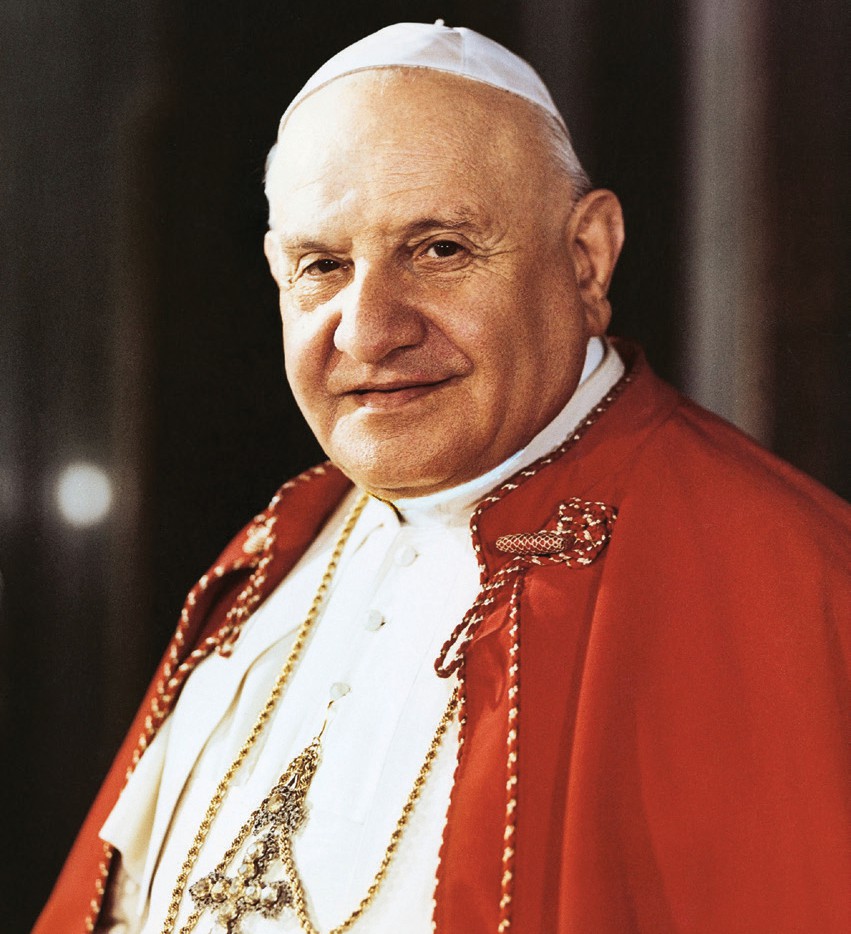
Pope John XXIII, the originator of the Second Vatican Council, known as “the priest of the world” and “the good Pope”, was born as Angelo Giuseppe Roncalli in Sotto il Monte, on 25 November 1881 as the fourth of thirteen children in a family of farmers. As a young boy, he came from the lowest of social standing and managed to preserve his simple and natural approach his whole life without any posing or aspirations of power. Thanks to his great sense of humour, and outstanding peacemaking and diplomatic skills he successfully mediated between Orthodox and Catholic believers, providing extensive relief in earthquake-stricken Bulgaria, saving the lives of countless Jewish refugees in Istanbul, and making important breakthroughs in dialogue between the various nations in Paris after World War II.
Yet the most remarkable act of this always modest, unassuming, serene man was undoubtedly when he convened the greatest ecumenical synod in the history of the Church. He began chronicling his spiritual journey from 14 years of age practically until the time of his death, which was later published as Journal of a Soul. He was ordained as a priest in 1904 and at a very young age served as secretary to the bishop in Bergamo, before serving as a stretcher-bearer and chaplain in the World War I. This was followed by a series of ecclesiastic positions from 1919: he was appointed president of the Society for the Propagation of the Faith, before serving as the Apostolic Visitor to Bulgaria for nine years from 1925.
The tireless and always smiling Roncalli, who was extremely socially sensitive, was faced with a desperate congregation in abject poverty, yet thanks to his pragmatism and optimism he defused the tension between the Bulgarian government and the Vatican and initiated countless reforms. From 1935, he spent another nine difficult years as a Turkish-Greek Apostolic Visitor and another seven years in Paris in 1944. The Church always sent him to those faced with the greatest hardships and he managed to bring peace and harmony wherever he went. In 1952, he was appointed the Patriarch of Venice and a cardinal in January 1953, before the peasant boy from Bergamo who shied away from power and greatness all his life was finally elected Pope in October 1958.
The man who had said “I am nothing” went on to become one of the greatest reformers of the Church. It is said that he was also surprised by the idea of the Vatican Council, yet he dutifully organised it for three years, believing the suggestion came from the higher planes. When five thousand people gathered in Saint Peter’s Square on 11 October 1962, marking the beginning of the council, he was already 82 years old and severely ill, diagnosed with stomach cancer. The bishops, cardinals and magistrates from almost all countries in the world gathered in Saint Peter’s Basilica to find forms of ecclesial renewal and to rethink the message of the Gospels together.
It was here that Pope John XXIII’s famous opening address highlighted the end of ecclesiastical judgments and excommunications. Many realised that instead of isolating themselves from the faithful, the clergy should go out amongst the poor and share in their fate. Through its decisions, the Council helped to continue the mission of individuals such as Mother Teresa, Father Foucauld, Raoul Follereau, Don Milani, or Abbé Pierre. Following the Council, the idea of ecclesial ecumenism gained momentum, as did initiatives such as the Dei Verbum approach, the declaration that the Word of God must be at the centre of the lives of the believers. This was also when each country was allowed to use its own language for the Holy mass, instead of Latin, and that priests could also appear in ordinary clothes.
This also marked the beginning of the Church’s reckoning with its former mistakes, which allowed the heads of the Churches of Rome and Constantinople to revoke the excommunication at the very end of the nearly four-year long Council, which was concluded by Pope Paul VI in December 1965, more than 900 years after the schism in the Eastern Church, and the two heads of Church embraced in front of a huge crowd of faithful. The crowning achievement of the lifework of Pope John is his encyclical on the subject of peace entitled Pacem in terris, which he wrote immediately before his death. His life came to an end on 3 June 1963. On 27 April 2014, both Pope John XXIII and Pope John Paul II were declared saints on Divine Mercy Sunday.
“The Pope is first and foremost and exclusively the supreme minister of humanity, called to win over souls to eternal salvation and to preserve and proclaim the truth in its purity. Truth and goodness are the two wings that lift the soul up high. Therefore, let us not seek to transform the figure of the Pope into the image and likeness of our own imagination.”
“The sense of my smallness and of my nothingness has always been my good companion, keeping me humble and content and granting me the joy of consecrating myself as best I can to the uninterrupted exercise of obedience and charity. I come from humble beginnings, and I was raised in a restraining, blessed poverty whose needs are few and which assures the growth of the highest and noblest virtues, and prepares one for the great ascents of life.”
“In my life I have always sought to be in the last place.”
“With the Council, I want to throw open the windows of the church and let the fresh air of the spirit blow through.”
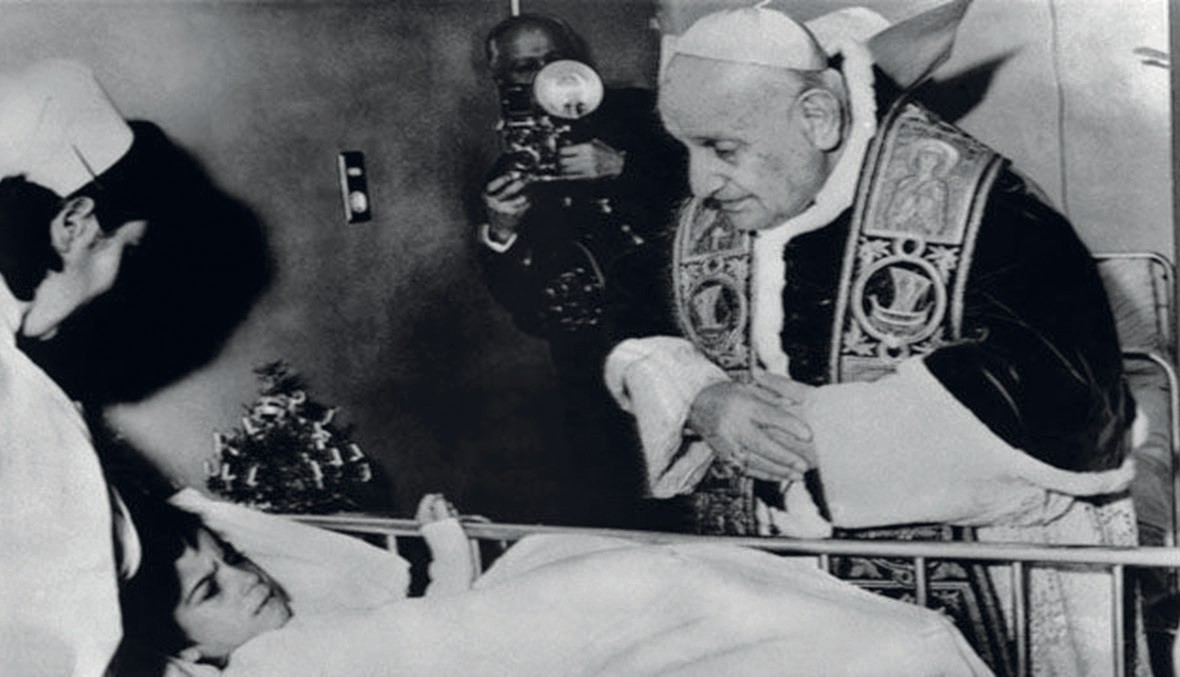
“There was the time when Pope John XXIII visited the Hospital of the Holy Spirit. All in a flutter, the religious sister in charge introduced herself, “Most Holy Father, I am the superior of the Holy Spirit!” To which John replied, “Well, I must say you’re lucky. I’m only the Vicar of Christ!”
“I am the servant of servants.”