Rose of Lima
1586–1617, Peru
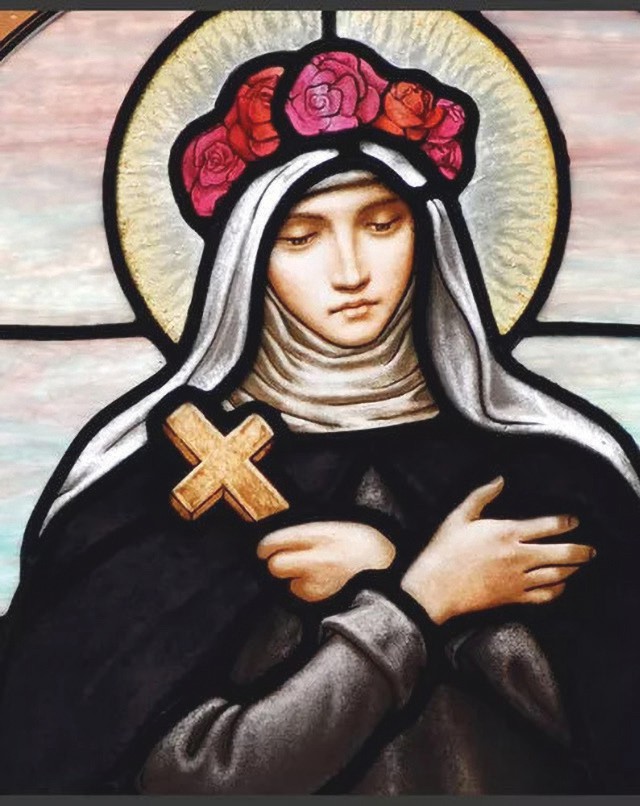
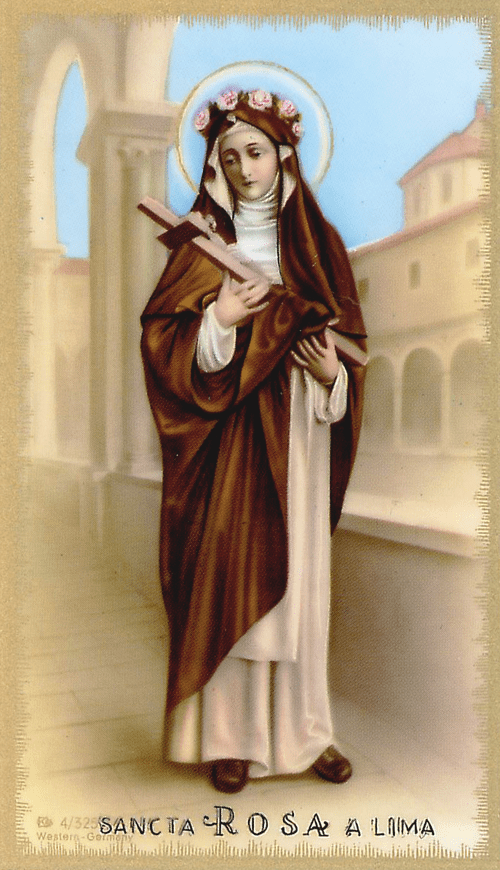
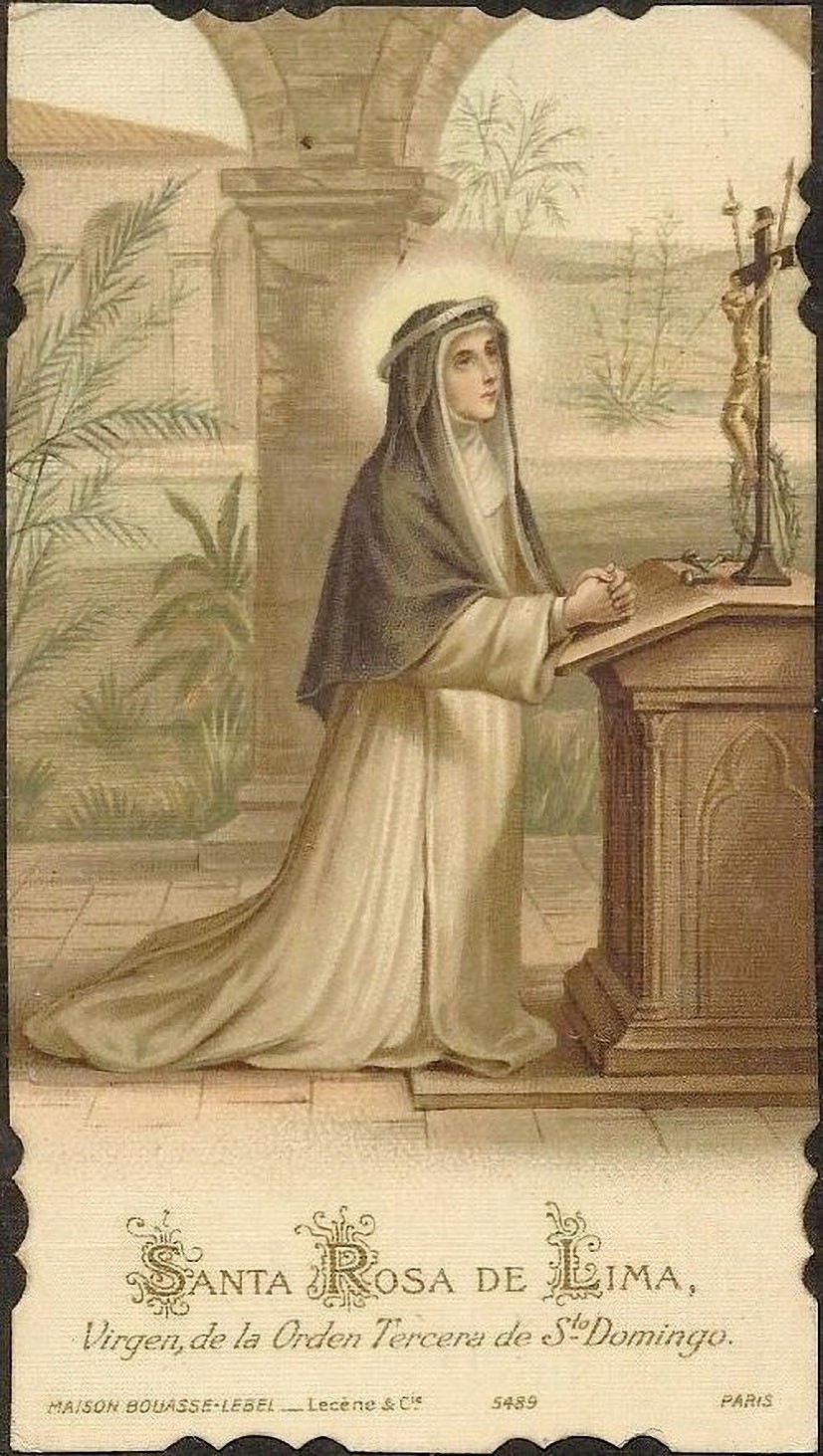
Saint Rosa of Lima, or Rosa de Santa Maria, the great saint of South America, was born Isabel Flores de Oliva in Lima, Peru, in April 1586 as the tenth child of a well-to-do family from a Spanish father and a local mother. Despite her brief life of only 32 years, she was venerated as a saint from the time she was born. Her last journey was so crowded that the viceroy’s soldiers had to protect her from the crowds clamouring for relics. What makes her life so extraordinary is that following the conquest of Peru, in an age of armed violence, she lived a life of virtue, unrelenting penance and asceticism, all alone and incomprehensible to others.
She was named Rose because her maid reportedly saw her face turn into a rose in the cradle. She was a wonderful child, always smiling, and the rest of her life was also marked by singing and cheerfulness. She learnt to read at the age of four, and even as a young girl she fasted three times a week and did hard penance in secret. At first a vegetarian, she later ate only bread and water. Her parents wanted to see her marry a distinguished husband, yet she took a vow of chastity and used all means necessary to hide her exceptional beauty. She endured reproaches and even beatings, yet remained firm in her resolve.
As the Dominican sisters had not yet arrived in Peru at the time, she joined the Third Order of St Dominic at the age of 20, and was capable of living a wonderfully free life in the garden of their house, in a hermit’s hut she built herself. She devoted twelve hours a day to devotion, ten to work and two to rest. She made lace and embroidery and tended the garden, and used the proceeds to support her destitute parents and the poor. Her great idol was St Catherine of Siena, and sometimes her face seemed to resemble hers.
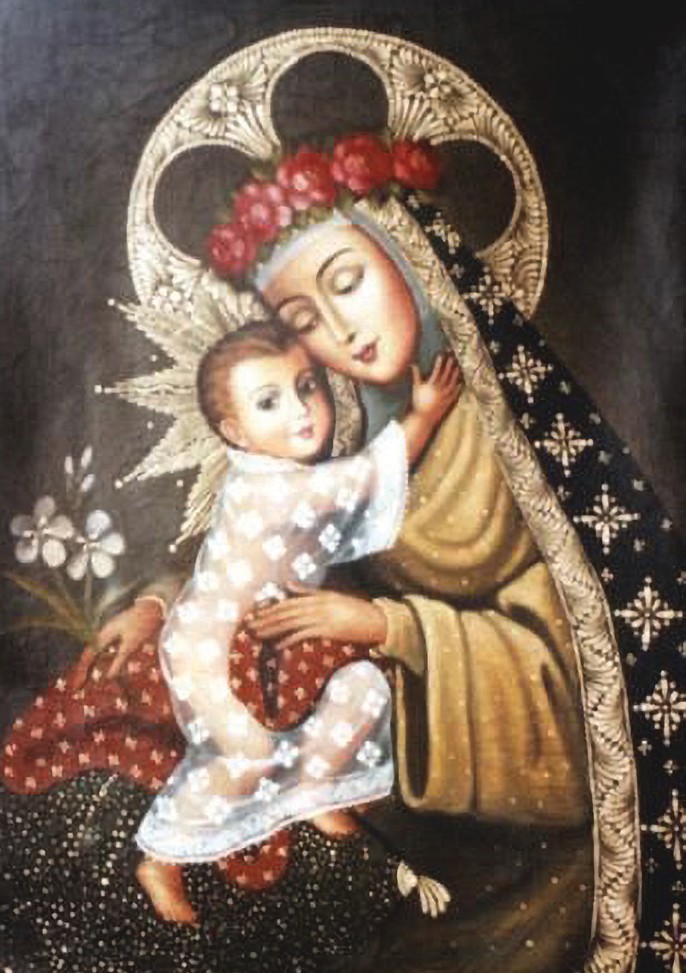
She understood the language of animals, and there are several stories about this in her biography. During last Lent, she was visited in the evenings by a little bird who took turns with Rose in singing her hymn of praise. Her room was filled with mosquitoes, yet they never bit her. In her most recent biography, there is a story of her talking to the plants in her garden at dawn: “Trees, grasses, praise the Lord!” The leaves of the trees began to rustle softly, the heads of the flowers bowed humbly and every plant stirred, each praising God in its own way.
Even among the greatest saints, few have been so tortured as this frail-bodied South American girl. “Lord, increase my sufferings, and with them increase Your love in my heart,” she was known to say. She wore chains around her waist, locked with a heavy padlock, and under her veil she placed a heavy crown of silver on her head. Whenever she was tempted or caught in some impropriety, she would fasten the wreath even more tightly on her head. As she wanted to do penance while resting, and found her grass-lined couch to be too comfortable, she stuffed it with pieces of wood. She believed that the suffering and penance offered was a means of making the world a better place. The Holy Inquisition investigated her several times, yet her shocking answers silenced her interrogators.
She spent the last three years of her life at her girlfriend’s house. In 1615, when Dutch warships attacked Lima, Rose prayed with the women of the city at the Santa Rosa Church. The Dutch fleet withdrew a few days later without attacking the city. Rose helped establish the first monastery in South America, the Monastery of St Catherine of Siena. She designed the building herself and raised the money to build it. She is also credited with providing regular care for the poor in Peru. Seeing the inhuman treatment of the indigenous people by the conquistadors, she looked for a way to do something about it and established the Indian Mission.
Her life was a continuous battle with evil, which she won. For five years she suffered an indescribable darkness every day. In her last weeks, she was tormented by pain that reached her bones. She described this as if a glowing helmet was pressing down on her head and as if a flaming sword had been stabbed through her heart. After three months of intense suffering, she died on 24 August 1617. She announced the day of her death in advance. In her final hours she said, “Jesus, Jesus, be with me always.” Her body did not decompose after her death, and is preserved intact at the Basilica and Convent of Our Lady of the Rosary in Lima, built on the site of her cell. The monastery has since become a known pilgrimage site.
“We cannot obtain grace unless we suffer afflictions. We must heap trouble upon trouble to attain a deep participation in the divine nature, the glory of the sons of God and perfect happiness of soul.”
“I stood in the full serenity of contemplation, in all-glowing splendour, full of wonder, I saw the cross of the Saviour appear in the midst of radiance. In this brilliant light I beheld the holy humanity of my Lord Jesus Christ. From His humanity I felt the inexpressible rays of majesty penetrating to the depths of my soul. I thought, I am perfectly free and have passed into the joy of eternal happiness.”
“If people would only know the inexpressible delight of the possession of divine Grace, this precious, joyful and blissful intoxication, no one would ever again complain of the cross they must bear.”
“The Cross is the only true stairway to Heaven.”
“Our Lord and Saviour lifted up His voice and said with incomparable majesty: “Let all men know that grace comes after tribulation. Let them know that without the burden of afflictions it is impossible to reach the height of grace. Let them know that the gifts of grace increase as the struggles increase. Let men take care not to stray and be deceived. This is the only true stairway to paradise, and without the cross they can find no road to climb to heaven.”