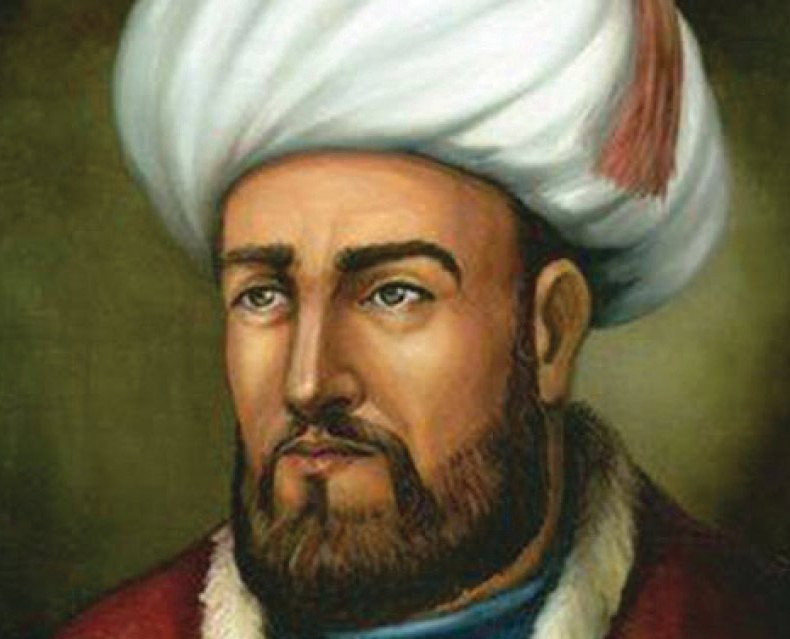
Al-Ghazali
around 1058 – 1111, present-day Iran
The Persian Sufi mystic Abu Hamid Muhammad bin Muhammad al-Ghazali was born around 1085 in an impoverished family living in the city of Tus, in the area of the present-day Iran. As a figure of Islam reform, he combined the traditional Sunni teachings with Sufi mysticism. His father was a deeply religious man – following his early death, Al-Ghazali and his brother were taught by a friend of the family as long as their inheritance lasted. In his hometown, Al-Ghazali gained insights into Islamic law and studied the Quran as well as writings on the life and teachings of the Prophet Mohamed. One of the pivotal moments in his life was when he was on his way home with the notes of the lectures of his teacher, Abu’l Qasim al-Isma-ili and the notes were stolen from him. Proving his courage, he retrieved them from the thieves, yet pondering deeply on what would have happened if the important teachings had disappeared forever, he retired for three years to memorise and memorise the written knowledge he had gathered. Subsequently, he studied under the famous teacher al-Juwayni at the local college in Nishapur.
Al-Ghazali excelled in his diligence and talent. Following the death of al-Juwayni, Al-Ghazali was invited to the court of Nizam al-Mulk, the mighty vizier of the Seljuk Empire, who was so deeply impressed by his vast body of knowledge that he appointed him the head teacher of the Islamic college in Baghdad in 1091. He taught hundreds of students while his fame and prestige increased, before he was faced with a serious moral and spiritual crisis. His whole life, he was driven by a quest for truth, yet alongside his growing success, the practice of a deeper religious life seemed increasingly distant. In November 1095, he quit his career, resolved all his outstanding matters and distributed his remaining wealth before leaving Baghdad. He started living the life of the poor Sufi while continuously engaged in writing and prayer. For a while, he lived in Damascus and Jerusalem before going on a pilgrimage to Mecca and finally settling in Tus, surrounded by his disciples with whom he essentially established a monastic community.
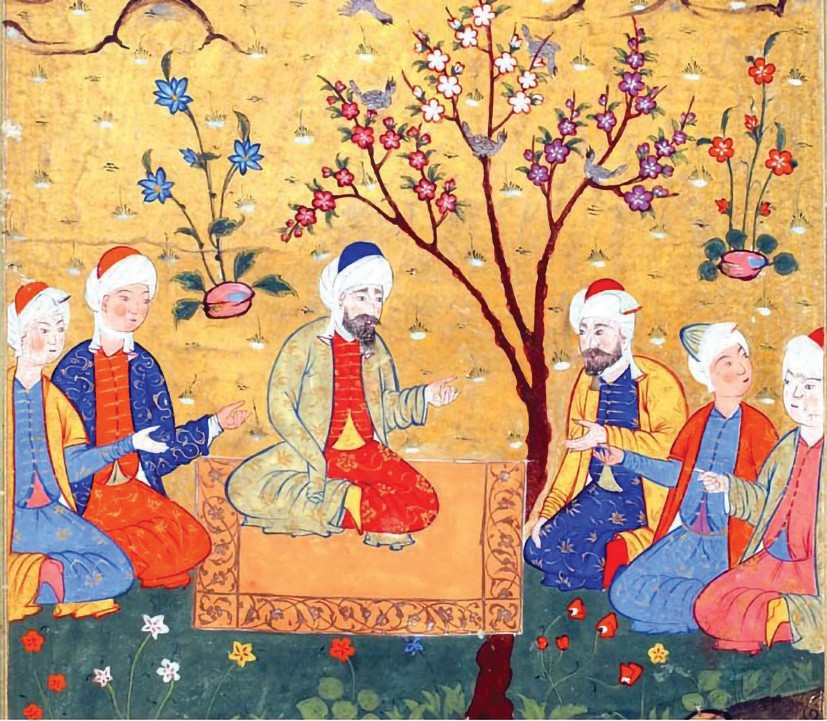
In 1106, they succeeded in convincing him to return to Nishapur and take up teaching again. The main argument in favour of this decision was that tradition dictated that a reformer of the Islamic community was to emerge at the beginning of every century, and his friends claimed that this person was Al-Ghazali. His mission was to transform Islam from a formal adherence to rules into an inner mystery of a living encounter with God. Over four hundred works were attributed to him, yet it is unlikely that he himself wrote so many of them. All of his works are full of lists, questions and counter-questions typical of works of scholastic philosophy. His works were lauded as the highest expression of the art of scholastic argumentation.
After deeming all philosophical teachings as having been refuted, he set out to construct a new system of theology in line with orthodox Islamic teachings. He believed that science should serve the purpose of religion and theology and that philosophy had a detrimental effect on religion. One of his well-known works, The Revival of Religious Sciences concerns Islamic teachings and doctrines and demonstrates how to build a deep and sincere religious life based on Islamic teachings, leading to higher levels of Islamic mysticism. His work entitled Deliverance from Error describes the way he forsake his worldly career and adopted a monastic way of life, whilst in his monumental work entitled The Alchemy of Happiness, he explains that happiness consists of the transformation of the “self ” and that this transformation stems from the recognition that man is first and foremost a spiritual being.
According to Al-Ghazali, ultimate ecstasy lies in identifying ourselves with the Ultimate Reality (God) through personal experiences. He stressed that this highest level of divine rapture would only be attained by a chosen few. These people are the prophets who appear in all times and places as messengers to remind us of the true and ultimate purpose of humanity. Al-Ghazali continued his lectures until 1110 before returning to Tus, where he passed away on 19 December 1111. He is lauded as being the “Proof of Islam”. The great religious significance of his person is well-mirrored in the following saying: if there had been a prophet after Mohamed, it would have been Al-Ghazali.
“In short, man in this world, is framed in infirmity and imperfection. But if he desire and will to free himself from animal propensities, and ferocious and satanic qualities, he may attain future happiness, will be more exalted and excellent than a king and will be enriched with the vision of the beauty of the Lord. But if he incline towards the world, and retain only the qualities of animals and wild beasts, his future state will be worse even than theirs.… Our refuge is in God!
“He who knows himself is truly happy.”
“The heart of the believer is between two fingers of the Merciful.”
“But I believe, with the certainty and vision of faith, that there is no power or might anywhere but with the high and mighty God. I believe that I did not set out on my journey, but he set me on my way; I did not act, but he acted through me. Therefore I ask him to first correct me and only then correct me through me, to first lead me and only then lead me through him. Let the truth be shown to me as truth, and give it to me that I may follow it; and let me see that what is false is false, and give it to me that I may avoid it.”
“O seeker after the divine mysteries! Know thou that the door to the knowledge of God will be opened to a man first of all, when he knows his own soul, and understands the truth about his own spirit, according as it has been revealed, ‘he who knows himself knows his Lord also’.”