Augustine of Hippo
354–430, present-day Algeria
Augustine of Hippo, or Saint Augustine, one of the most influential Christian theologians and the Bishop of Hippo, was born Augustinus Aurelius on 13 November 354 in the area of the present-day Algeria, in a town named Tagaste. He was responsible for establishing the first Christian monasteries in North Africa. As the Bishop of Hippo, he was involved in a great deal of organisational work and his writings had a major influence on the later development of Christianity. Still, opinions are divided on his activities. Some historians refer to him as the first dogmatist of the Inquisition. Although he was horrified by bloodshed his whole life, he still played a major role in the persecution of Manichaeans as heretics. His life was rife with contradictions. His mother, Monica – who was later beatified – was a devout Christian, while his father, the pagan Patricius was a man with a violent temper and a restless nature. Augustine himself was rather hot-headed, which caused him much grief.
His youth was characterised by an insatiable thirst for knowledge, as well as a lack of discipline and the pursuit of youthful pleasures. His desires would not let him rest, and he had an illegitimate child. Prior to his conversion, he was a successful teacher working in Carthage, Rome and Milan, and a brilliant orator whose captivating style won him a huge following. Augustine’s Confessions, the compelling account of his passionate youth and his conversion to Christianity became one of the most widely read Christian books and had a profound impact on countless people and sparked many conversions. Initially, Augustine turned to the Manichaean faith in search of a way out of the aimlessness of his early life, before leaving the Manichaeans under the supervision of a bishop well-versed in Platonic philosophy. The idea of conversion increasingly matured in his soul. From his biography we know that he cried, prayed, begged and even cried out in his inner hopelessness.
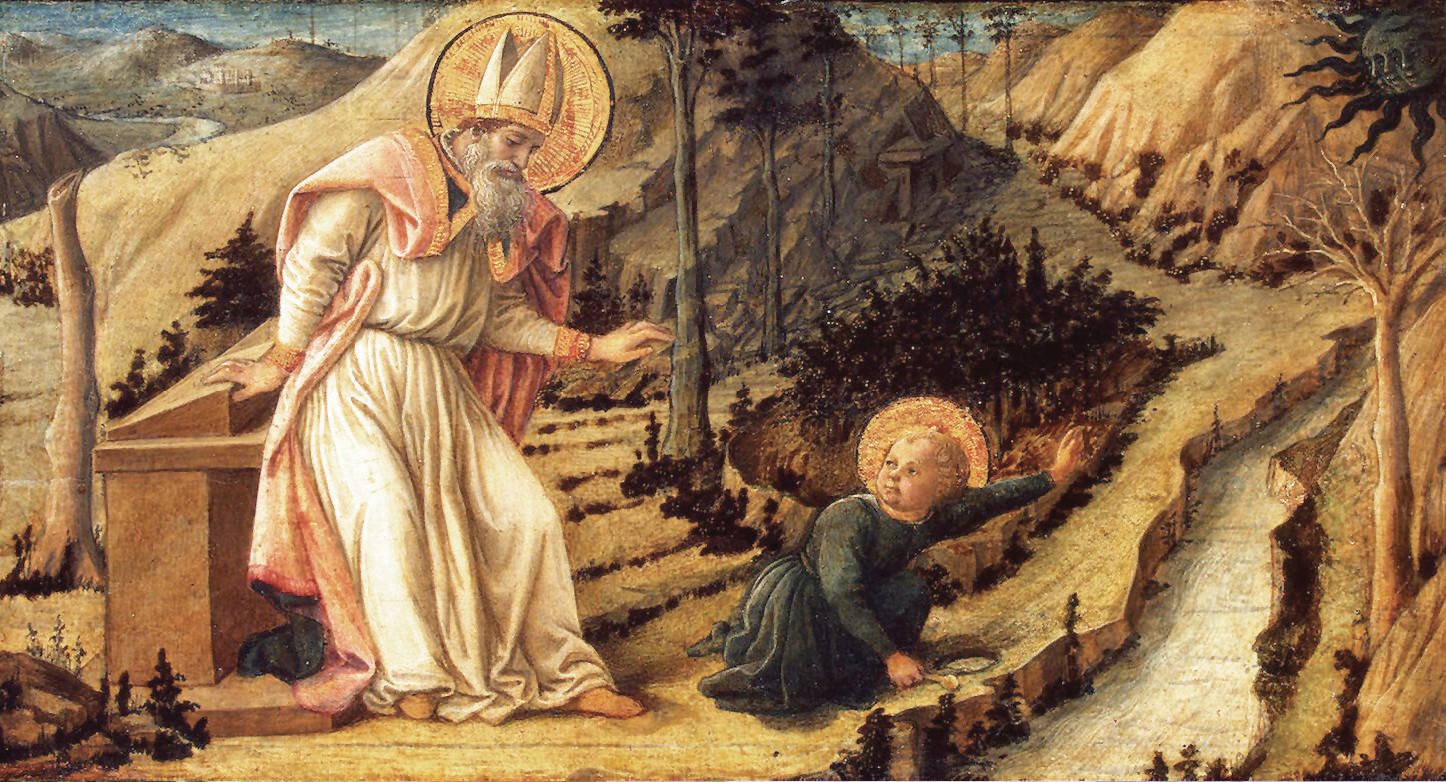
It was a defining experience in his life when he unexpectedly heard a child’s voice speaking to him saying, “Take up and read.” He then took the Scripture that lay before him and opened it at the following passage: “Let us behave decently, as in the daytime, not in carousing and drunkenness, not in sexual immorality and debauchery, not in dissension and jealousy.” (Romans 13:13–14.) This was God’s answer to Augustine, whose heart was suddenly filled with faith and certainty. Augustine’s conversion was closely tied to this event. Soon afterwards he ceased teaching and was baptised by Bishop Ambrose on Easter 387. Following his mother’s death, he sold all his goods with the exception of his house in Tagaste. Here, together with five friends, he founded the first monastery in North Africa as a small community where they lived a monastic life for three years. After years filled with prayer, asceticism and spiritual discussions, he was unexpectedly charged with a task, which he accepted. He was made the coadjutor of Hippo, before being appointed bishop five years later.
He held this office with great dedication and conscientiousness for more than thirty years, until his death. In addition to all the duties of the bishopric, he wrote nearly a hundred books including a summary of the history of the Christian Church in North Africa. His work far exceeded the fields he worked in – he became one of the most influential theologians of the Catholic Church. Along with Thomas of Aquinas, he was an important founder of Christian theology, and alongside Basil the Great and Benedict of Nursia, he was the most important legislator of Orthodox and Western monasticism. For more than a thousand years, the regula they developed has helped millions of men and women strive for a pure life. Shortly before his death, at the age of 76, Saint Augustine posted four penitential psalms on the wall of his room so he could always read them. He asked to be left alone to prepare to meet the Creator in prayer, penance and tears. On 28 August 430, he departed from the earthly world, while his beloved city of Hippo was besieged by the vandals.
“Lord I went wandering like a stray sheep, seeking you with anxious reasoning weighted within me. I wearied myself much in looking for you without. Yet you had your habitation within me…I went around the streets and squares of the cities of this world and found you not, because in vain I sought without for you who were within.”
“…hesitating to die to death and to live to life, and the worse that was familiar in me carried more weight than the better that was unfamiliar. And the very point of time at which I was to change, the closer it came, the more horror it struck in me, but it did not drive me back, nor turn me aside, but left me in suspense. Trifles of trifles held me back, and vanities of vanities, my old friends, and they pulled at my fleshy garment”
“…for in the direction I had set my face, and yet toward which I still trembled to go, the chaste dignity of continence appeared to me–cheerful but not wanton, modestly alluring me to come and doubt nothing, extending her holy hands, full of a multitude of good examples–to receive and embrace me…”
“There can be salvation for the soul as long as there is even one who is damned. There can be no peace as long as there is even one who suffers.”
“You should not seek to please by your apparel, but by a good life!”
“Love and do as you wish!”
“Let all of you then live together in oneness of mind and heart, mutually honoring God in yourselves, whose temples you have become.”
“Love, love with your life!”