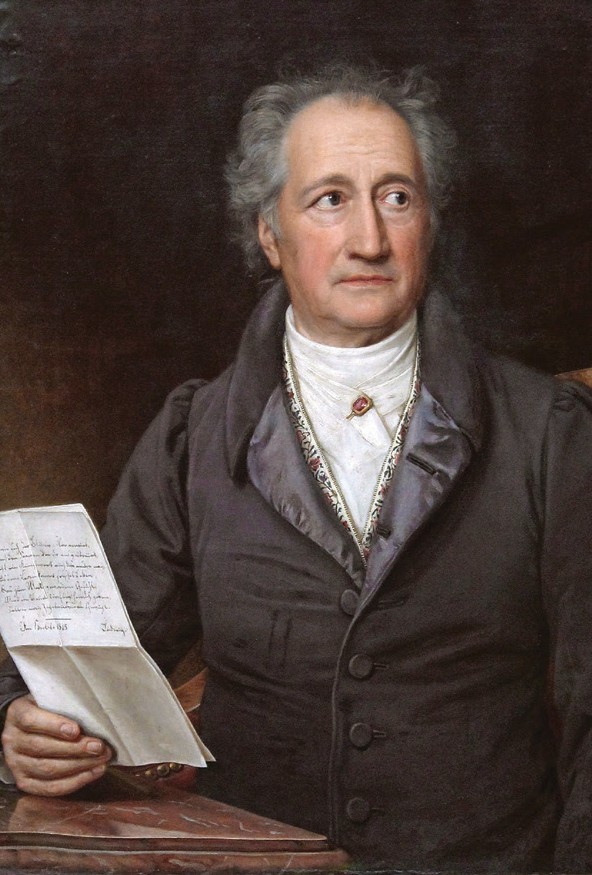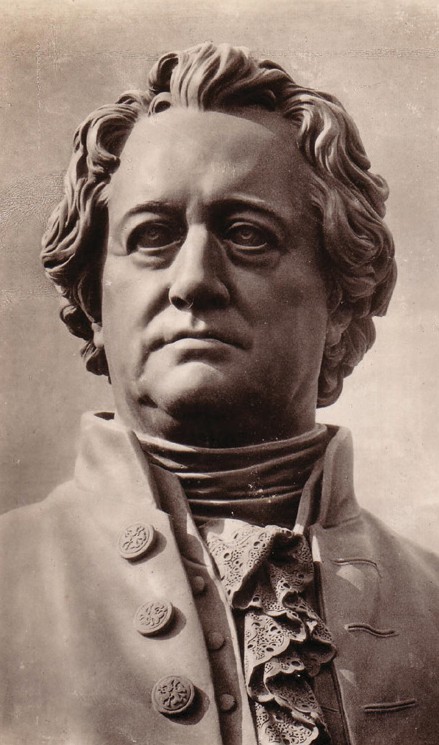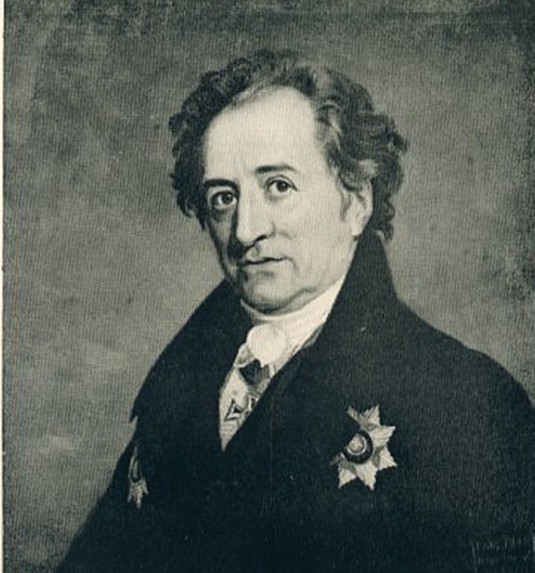
Johann Wolfgang von Goethe
1749–1832, Germany
Johann Wolfgang von Goethe, polymath scientist, artist and one of the most influential thinkers in modern history was born on 28 August 1749 in Frankfurt in a well-to-do bourgeois family. The landmark significance of Goethe’s life work is shown not only by the fact that he was capable of creating something new in countless fields including both science and art, but also by the fact that his life combined scientific insight with the achievements of a spiritual approach to man and art, and thus he was at once an advanced scientist, artist and believer. The many areas in which he created something new and lasting have been compiled in forty hefty volumes for posterity.
He lived an exceptionally adventurous life filled with traveling. He learned Latin, Italian, Greek, French and English at a young age, in order to read the original works of the great writers of the world. He published his first book of poetry at eighteen years of age before he was assailed by pulmonary haemorrhaging a year later for more than two years, which even caused his digestion to shut down for a while. He was cured by a Rosicrucian doctor known as Metz without the use of the scientific methods of age. Following his recovery, Goethe delved into alchemy, yet at his father’s urging, he began studying law.
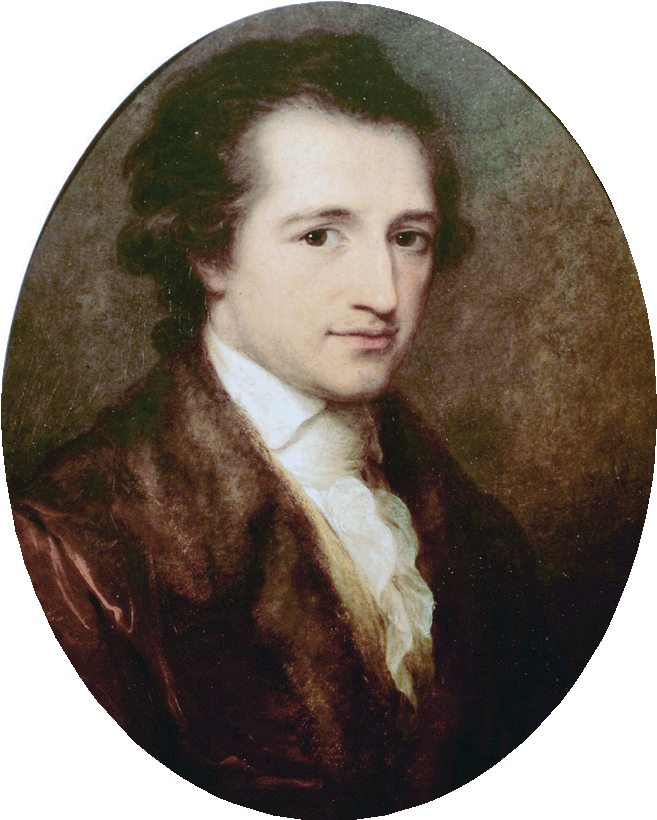
At twenty-two years of age, he was already working as a lawyer in Frankfurt and later in Wetzlar, where he served as an apprentice at the Imperial Chamber Court. At the same time, he was already working on his greatest work, Faust, befriending the philosopher-poet Johann Gottfried Herder and joining the Sturm und Drang movement to counter the influences of the bourgeoisie. He was also gathering folk songs at the time. Later, Ludwig van Beethoven himself is said to have said, on seeing Goethe’s scores, that he had never met a composer of such genius. The period between 1775 and 1786 proved to be of key importance, which he spent at the side of Karl August, Duke of Saxe-Weimar-Eisenach. As a trusted friend and mentor of the Duke and a court advisor, cultural policy director, diplomat and finance minister, he also initiated reforms in the military and road development. He also worked on a number of anatomical drawings in this period and even discovered a previously unknown bone in the human body.
He escaped from his official duties to Italy, where he lived under an alias, studying local art and continuing his botanical studies. He was only willing to return to Weimar in 1788 with the proviso that he would be relieved of his official duties. The Mediterranean country’s art is said to have had a major influence on him and led him to establish the approach later known as German Classicism. His relationship with his friend and peer, Friedrich Schiller was also the most inspirational in this period. Goethe then went on to create something new year after year, including the following: he developed his theory of metamorphosis, understanding and explaining the notion of the so-called primordial plant, he created his own theory of colours, thus reforming the Newtonian theory of colours as well as writing fourteen volumes on various subjects related to natural sciences. He also penned important works on anatomy as well as epistemology.
He studied epic poetry, Orientalism, and reinterpreted the works of Leonardo da Vinci, and for a while even served as a theatre director in Weimar, where he directed plays and was engaged in the training of actors. He also founded newspapers, in which he regularly published his writings; he had the time to dabble in Slavic folk poetry and was even involved in state administration again and served as a minister from 1814. His literary achievements are particularly noteworthy, resulting in a number of works (Faust, The Sorrows of Young Werther, Wilhelm Meister’s Apprenticeship, Torquato Tasso, etc.) that had a definitive impact on the literature of the world. Goethe’s worldview and view on life combines a spiritual outlook with a practical approach, and a comprehensive overview of the material world. Goethe represents a kind of essence of human culture, which researchers usually refer to as “the awakening of the spirit of Central Europe”. The cult of Goethe (or Goetheanism) is still well and truly alive today, as one of the greatest fruits of German and European humanity. An increasing number of thinkers believe that in appreciating Goethe, Europeans can honour and elevate themselves to a stature befitting mankind.
“The way you see people is the way you treat them, and the way you treat them is what they become.”
“The real scholar learns how to evolve the unknown from the known, and draws near the master.”
“If you start to think about your physical or moral condition, you usually find that you are sick.”
“The right man is the one who seizes the moment.”
“Passion! Drunkenness! Madness! You stand there so complacently, without any real sympathy, you moralists, condemning the drunkard, detesting the madman, passing by like the Levite and thanking God that you are not made as one of these…. my passions have never been very far removed from madness, and yet I do not feel any remorse. For I have learned in my own way that all unusual people who have accomplished something great or seemingly impossible have always been proclaimed to be drunk or mad.”
“Love of truth shows itself in this, that a man knows how to find and value the good in everything.”
“The life of man appears a glorious fate:
/ The day how lovely, and the night how great! /
And we ‚mid Paradise-like raptures plac’d,
/ The sun’s bright glory scarce have learn’d to taste.”
“Nature is so perfect that the Trinity couldn’t have fashioned her any more perfect. She is an organ on which our Lord plays and the devil works the bellows.”
“What is uttered from the heart alone, Will win the hearts of others to your own.”