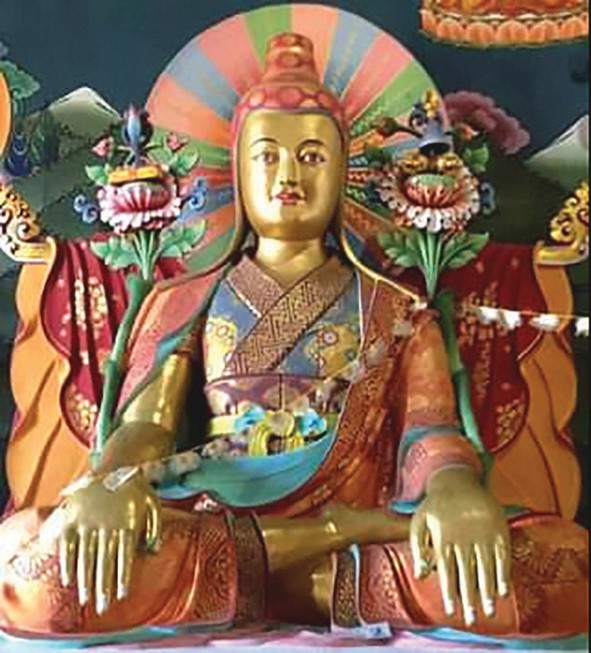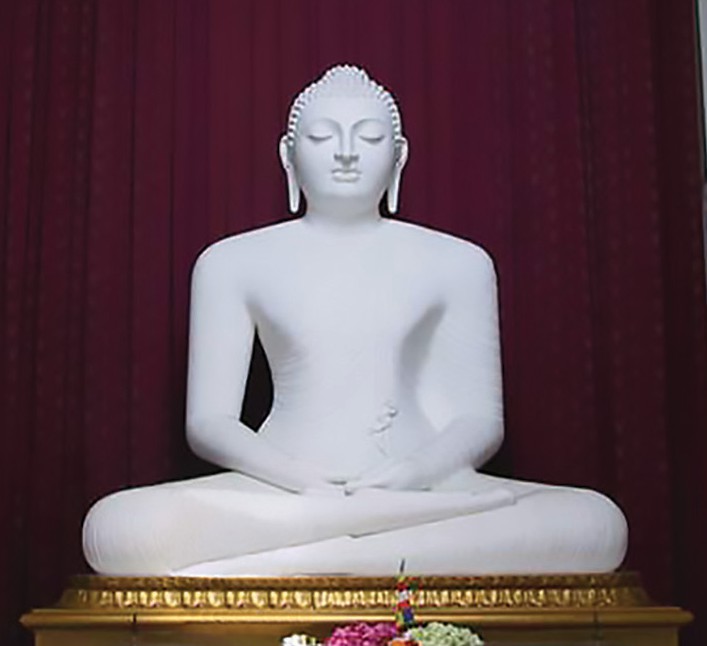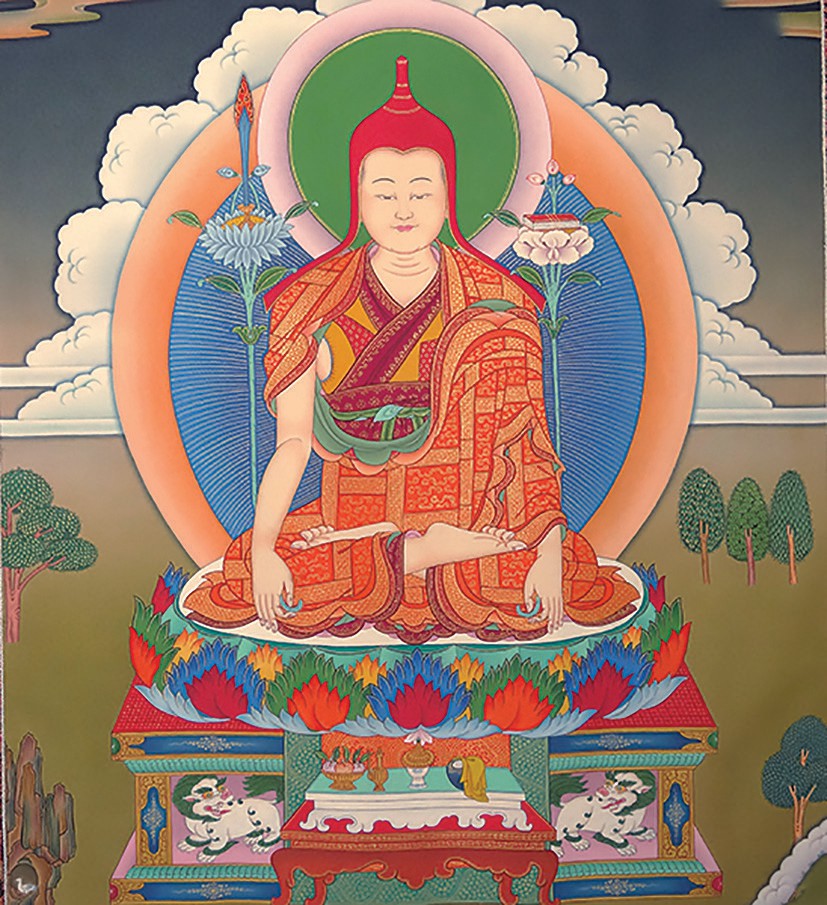
Longchenpa
1308–1364, Tibet
Longchen Rabjam, more commonly known as Longchenpa, was one of the greatest scholars and masters of the Nyingthig Order. He synthesized the various teachings of dzogchen (or atiyoga, meaning the yoga of primordial origin) into a single doctrine and he is credited with the elaboration of the concept of ‘total perfection’ without duality, which he tried to distil as much as possible through poetic imagery and similes. Longchenpa is regarded by Tibetans as one of the three Tibetan incarnations of the Manjushri Bodhisattva, who personifies the wisdom of the Buddhas.
He was born on 10 February 1308 in Dörong in central Tibet, in the fertile Dra valley. Both his father and grandfather were initiated yogis. His father, Master Tsensung, was a renowned scholar and abbot of Töndrong village, and his mother was a descendant of Dromza Sönamgyen, the founder of the Kadampa order. Tradition has it that at Longchenpa’s birth, a protective spirit appeared in the form of a black woman wielding a sword, holding the child in her upraised hand and saying: “I shall protect him!” Longchenpa could read and write from the age of five, and at seven he was initiated into various texts and rituals by his father, and also studied medicine and astrology.
Following the death of his parents, at the age of twelve, he was sent to the Samye Monastery, the oldest Buddhist monastery in Tibet, located southeast of Lhasa. In his ordination, he was given the name Tsultrim Lodrö, or ‘The Disciplined Mind’. He first became a master of the monastic rule and taught it to others at the age of fourteen. Longchenpa’s training lasted for more than twenty years. He received initiations and explanations – the nyingmapa – of the tantras and termas (hidden teachings) representing the religious traditions of the old and new orders. From the age of sixteen he received further teachings and initiations from various masters. At the age of nineteen, he entered the famous monastic college of Sangpu Neutok, where he received a degree encompassing the religious education of his time. He studied the Sanskrit language, the theory of poetry and composition, the five major sciences and the philosophical texts of the Abhidharma. He then embarked on a study tour of the various institutions. The name Longchenpa also means “the crucible of the here and now” in Dzogchen esotericism.
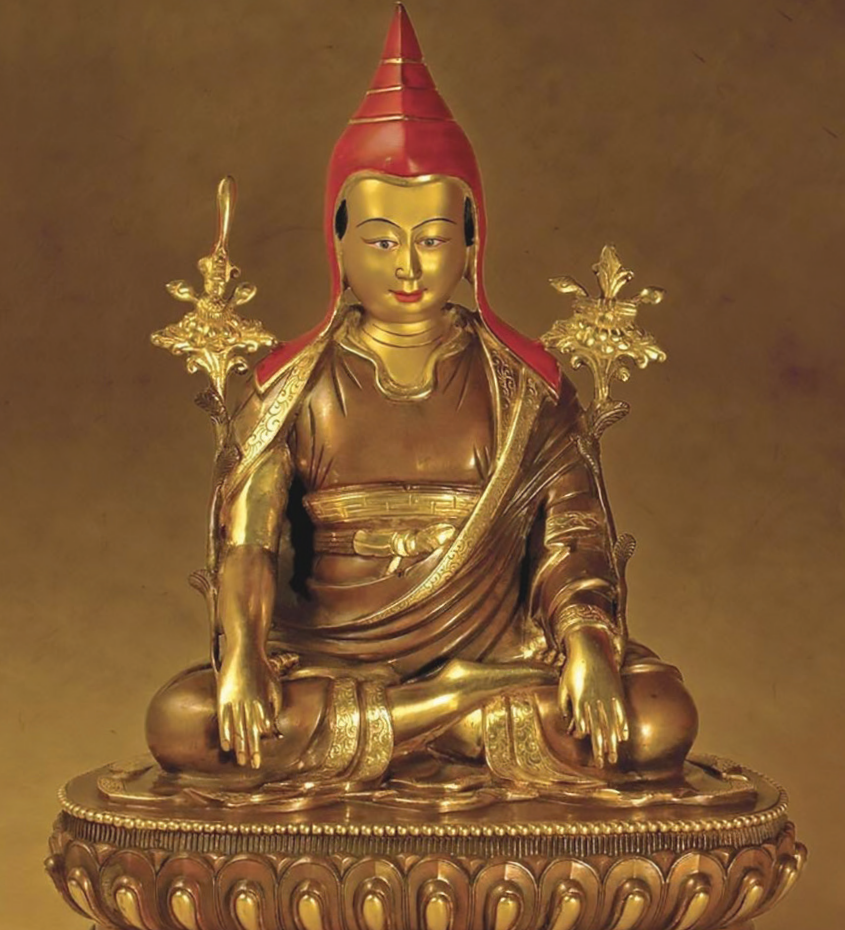
He then returned to the Samye monastery, yet his innovative activities were not looked upon favourably and many people envied him. Due to the growing misunderstandings and undeserving attitude of the disciples, he left the monastery at the age of twenty-seven and retired to a cave. There he had a special vision. He received a blessing from a deity who appeared before him in the form of a beautiful young woman and placed her crown of precious stones on Longchenpa’s head. At the age of twenty-eight, he sought out Kumaradza, the master of the dzogchen teachings, who had a prophetic dream that Longchenpa would be the repository of his knowledge. He studied for two years under extremely harsh conditions with Kumaradza, who lived a nomadic life. In return for his teachings, Longchenpa offered his internal bounty while plagued by doubts as he felt that what he was giving was too little. He wanted to leave the valley where they resided, yet his master sensed his thoughts and persuaded him to stay.
Later that year, he imparted several initiations and important teachings. Through their joint work, they combined the two main groups of dzogchen teachings from Garab Dorje into a third set of so-called nyingthig, or ‘heart drop teachings’ known as the Vima Nyingthig, codifying them as a common foundation for the nyigma and kagyu traditions. Longchenpa attracted more and more disciples, despite spending a great deal of time in mountain caves. As a hermit, he also created countless extraordinary things. One of his important works is the Maya Yoga, a beautiful expression of the dzogchen’s concept of emptiness. The dzogchen approach emphasises the perfection of the moment. According to this view, in the “here and now” all things arise from pure consciousness, and nothing is ever divorced from the pure nature of consciousness.
During one of Longchenpa’s stays in Bhutan, his son and daughter were born. His son Drakpa Özer also became a representative of the Nyingthig lineage. In 1354, he miraculously escaped an assassination attempt and went into voluntary exile in Bumthang, Bhutan. From here he later returned to central Tibet. He died in Chimpu in 1364, aged 56.
“In the universal womb that is boundless space all forms of matter and energy occur as flux of the four elements, but all are empty forms, absent in reality: all phenomena, arising in pure mind, are like that. just as dream is a part of sleep, unreal in its arising, so all and everything is pure mind, never separated from it, and without substance or attribute. experience is neither mind nor anything but mind; it is a vivid display of emptiness, like magical illusion, in the very moment inconceivable and unutterable. All experience arising in the mind, at its inception, know it as emptiness!”
“Although forms appear to the mind, the (objective) appearances are not mind…. When the reflection of your face appears in a mirror, it appears as the face looks, because the clear surface of the mirror is capable of making the reflection appear and the face has the potential of appearing or of projecting the reflection. At that time, the reflection of the face is not the face, nor is there any other face than the face which imprinted it.”
“The world of the senses, landscapes and creatures, happy and sad feelings, and waves of moods, all are absences, but they can be experienced as the dark shadow of our lantern, as the double vision our eyes show us after we press them, as the projection of our fears into the dark night. They have but only a nominal value, and disappear on closer scrutiny, yet deep insight reveals their wide-open nature, uncreated, like the sky, timeless, primordial. We can see them here and now!”
“Absence is the essential emptiness of reality. Whatever appears in the endless space of sky-like mind has no self-sprung awareness.”