Nagarjuna
around 150 CE–around 250 CE, India
The great monastery-founding Buddhist master Nagarjuna was born in Kahora, East India, around 150 CE. He played an extremely important role in the spread of Buddhism in India. His life is closely tied to many legendary stories and mystical elements that are difficult for Westerners to understand. To make matters more complex, there were multiple masters in India known as Nagarjuna, and the legendary tales of their lives are difficult to separate from those of the great monastery builder himself.
Nagarjuna was born to a couple who had yearned to have a child for a long time in a kingdom in the vicinity of Vidarbha. He was predicted to live only seven years, seven months and seven days. His parents believed the prophecy and sent him to a secluded place before he turned seven. At the advice of his guardian, the child was sent to the Nalanda Monastery-University, where the head of the monastery, Saraha, advised him to pray to Amitabha, the Buddha of Long Life, and to perform certain special practices. In this way, the young man managed to escape the effects of the prophecy and survived.
Thereafter, he began to study the Buddha’s discourses in earnest, acquiring many extraordinary abilities, and was nourished by a special inner strength. Tradition has it that he became a disciple of a master known as Rahula. He once was undisciplined and conjured up rain for his own purposes, for which he was reprimanded by his master, as such an act was unworthy of a Bodhisattva (a compassionate, selfless being who devotes his life for others). As penance, his master ordered him to build 108 monasteries, a thousand temples and ten thousand shrines.
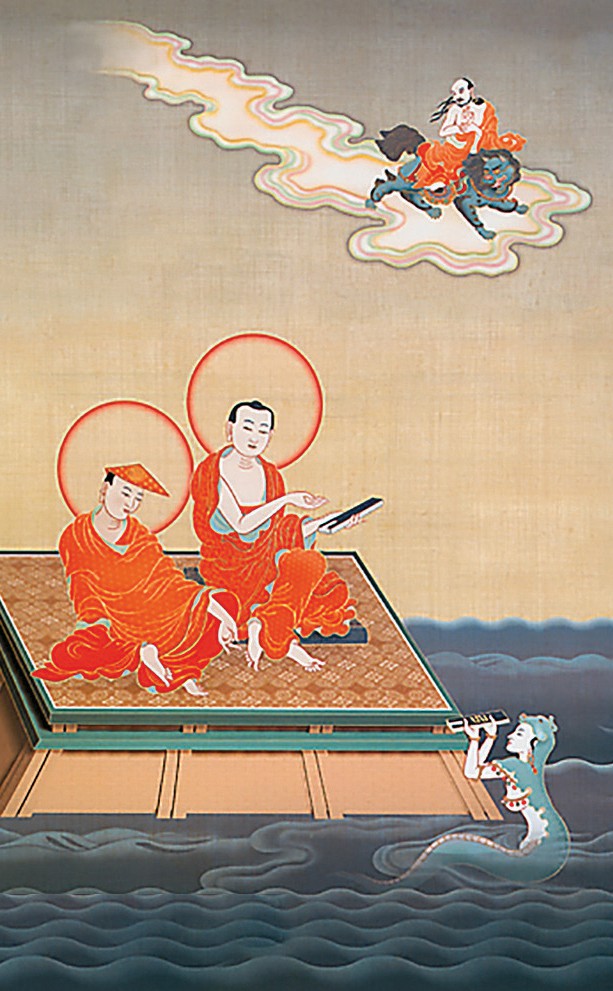
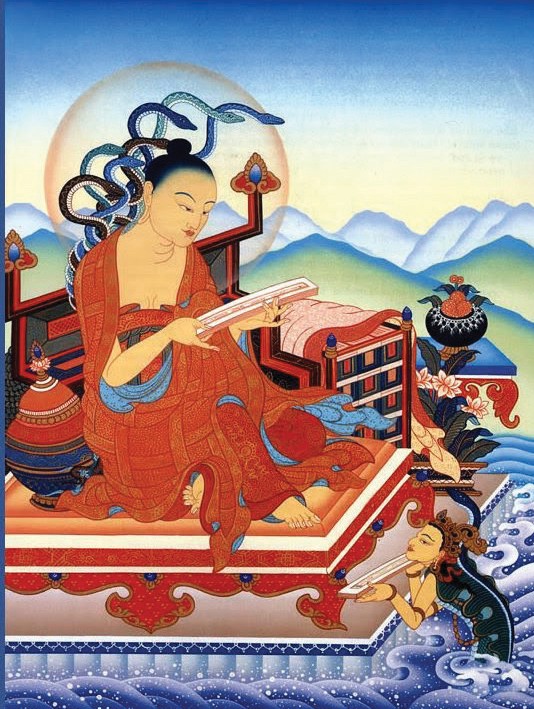
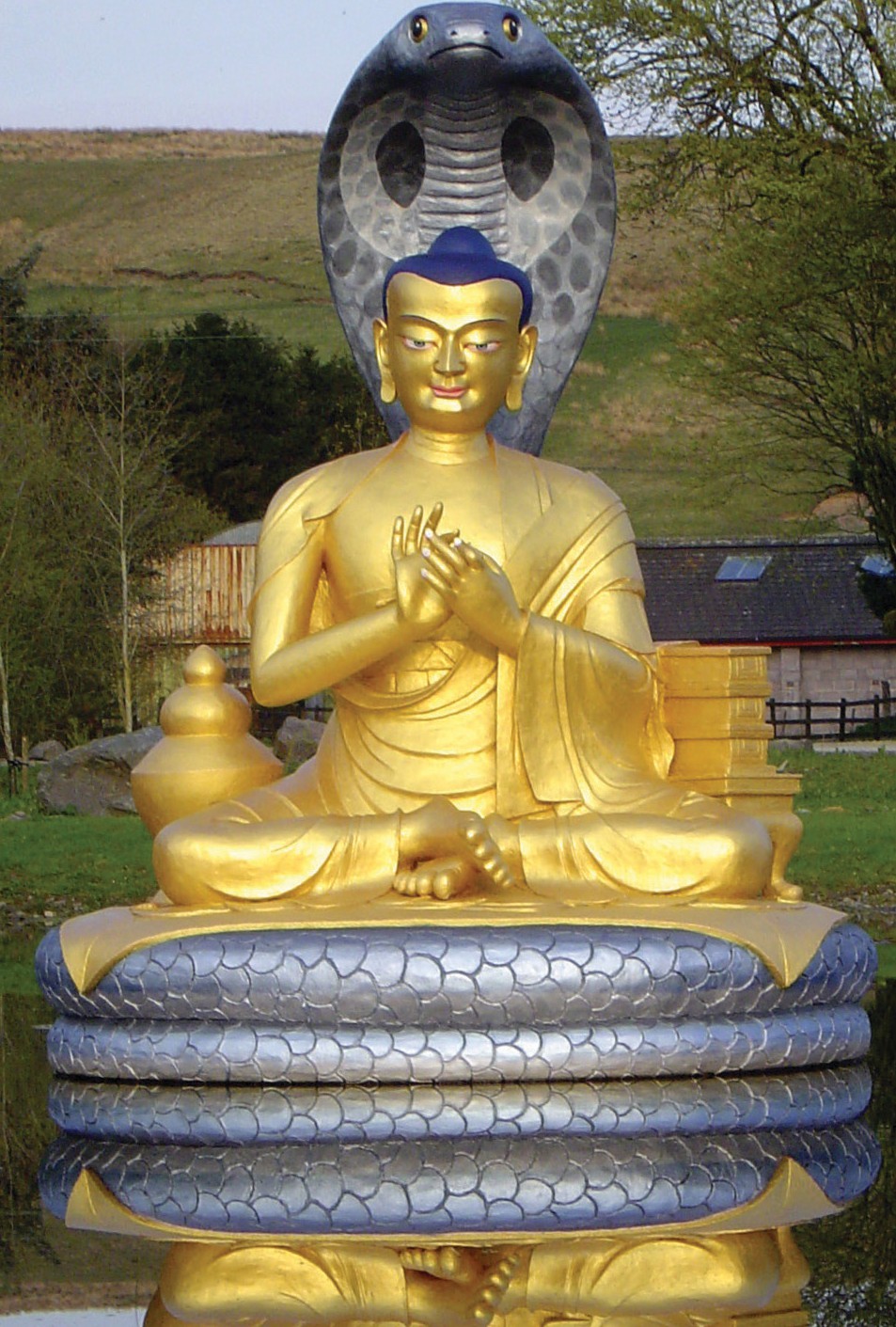
Upon the completion of this task, Nagarjuna’s great work began. Although these are most certainly only symbolic numbers, according to some sources, the foundations of all these sites were actually established and Nagarjuna summoned the Naga, a mystical, benevolent being in a serpent’s body, and with their help, he established the foundations of the buildings. According to another story about Nagarjuna, he wrote a work at the request of the Nagas entitled The Thousandfold Wisdom of the Nagas, in which he expounded the Buddha’s teachings to them, earning him the name of Nagarjuna.
During his educational journeys, he travelled outside India, founding shrines and temples wherever he went. After the death of his master, he became abbot of the Nalanda monastery. That was when he began to convey the teachings of the Mahayana tradition, the philosophy of the middle way. He held everyone in the monastery strictly accountable to the monastic rules. Once, when he put them to the test, legend has it that eight thousand monks were banished from the monastery, which was so vast that it was home to nearly fifty thousand monks. He was instrumental in the spread of both main branches of Buddhism (the Mahayana and Hinayana traditions). Although Mahayana and Hinayana were not terms used in the modern sense at the time, Buddhist tradition regards the community led by Nagarjuna as a Mahayana sangha, yet Nagarjuna is also recorded as having overseen Hinayana communities as well.
It was his disciples who later developed the Buddhist school of philosophy known as Yogachara. The Nalanda monastery later served as one of the main centres of the Buddhist world, at one time even eclipsing the reputation of the school founded at the Buddha’s holy site in Bodh Gaya. It is said that the King of Otisa (now Orissa) and the ruler of the Dhara Kingdom also adopted Nagarjuna’s teachings along with their subjects. Nagarjuna was both a teacher and a friend of the ruler of the Satavahana dynasty. Nagarjuna wrote the seminal works Madhyamaka (Philosophy of the Middle) and the Mulamadhyamakakarika (Root Verses of the Middle Way), as well as many other important Buddhist works. The antecedents of one of these is that on one occasion, when a group of children were playing, he predicted that one of them would become king (which later came true). He dedicated his works Ratnavali (Precious Garland) and Suhrllekha (Letter to a Good Friend) to him.
“Give with reverence, sacrifice to those worthy of sacrifice, be a friend: in short, that is the teaching.”
“To whom Emptiness makes sense, everything makes sense. To whom Emptiness does not make sense, nothing makes sense.”
“Just as the Sun dispels darkness, the perfect sage has conquered the false habits of mind.”
“A wise person is one who having accurately analyzed all actions of the body, speech, and mind, always acts for the benefit of self and others.”
“Do not consume alcohol and live a modest, harmless life!”
“Those not esteeming the great path of excellent doctrine
/ Bright with giving, ethics, and patience, / Afflict their bodies, taking / An aberrant path like a cow path [deceiving oneself and those following].”