Rabindranath Tagore
1861–1941, India
Rabindranath Tagore, the Nobel Laureate apostle of poetry and the arts, was born in Jorasanko, the cradle of the Bengal Renaissance, into one of India’s oldest and most well-established families on 7 May 1861. His father was the religious innovator Debendranath Tagore, who had eight sons and six daughters. The young Rabindranath and his siblings were raised with a strict discipline, yet also in a peculiar freedom: they were surrounded by a magical atmosphere that encouraged art and creativity, expressed mostly through colours, sounds, smells and songs. Thanks to this, as well as the labours of his ancestors, the family, which Tagore described as a unification of three (Hindu, Muslim and British) cultures, became one of the most influential families in Indian culture.
One of his brothers invented Bengal shorthand and musical notation, while his other brother was the first Indian of the British administration, and the third became one of India’s most distinguished contemporary artists. Rabindranath became a Nobel Laureate author, while his father was a key organiser and leader of the Brahmo Samaj movement alongside Ram Mohan Rai. This movement, which sought to consciously adapt outdated Hindu rituals and traditions to the changes of the modern age, enjoyed enormous popularity for its revolutionary ideas. Rabindranath himself was involved in this renewal work, before traveling to England and absorbing the foundations of Western culture.
He opened up thanks to these influences and began his poetic and literary activity. From this blend of colours, sounds, scents and poetic forms, Tagore renewed his unique art of Kirtan (praise singing), which gave rise to his passionate Bengal song adaptations that are practically untranslatable into European languages, praising God and following in the wake of his great predecessors Kabir and Tulsidas. He was also active in politics and public life, and was the father of two sons and two daughters.
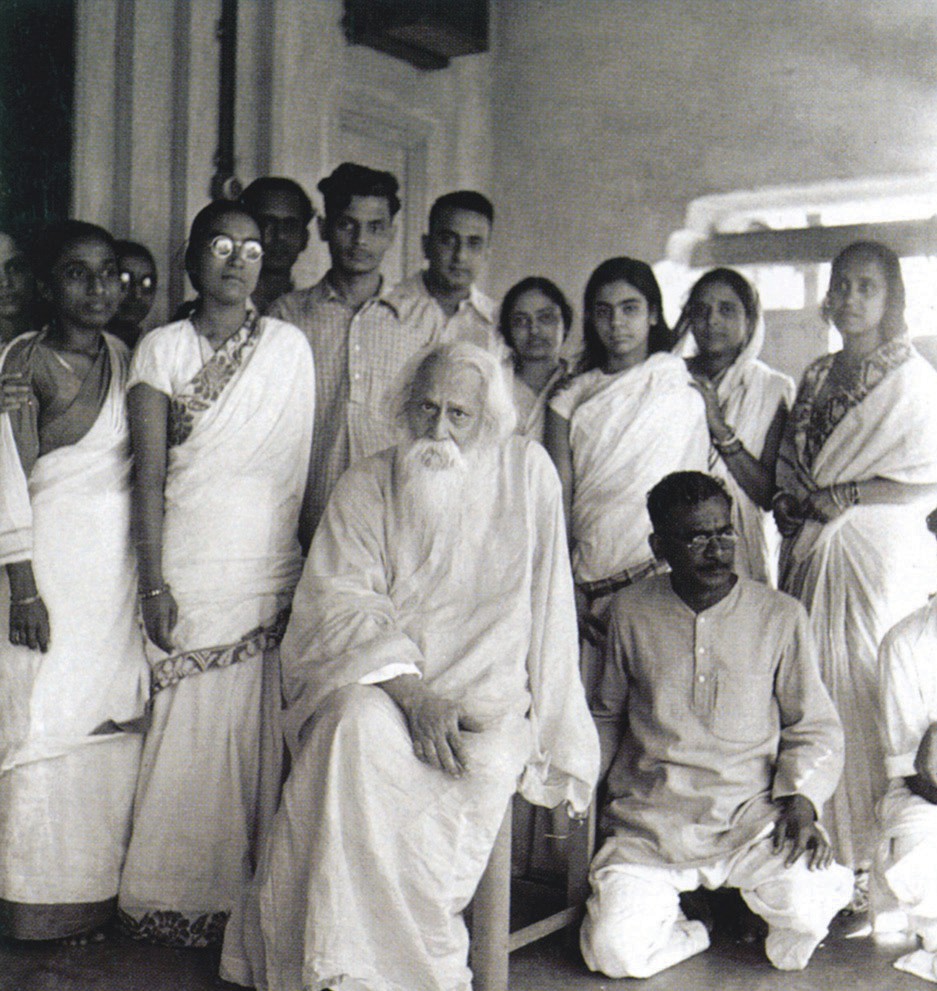
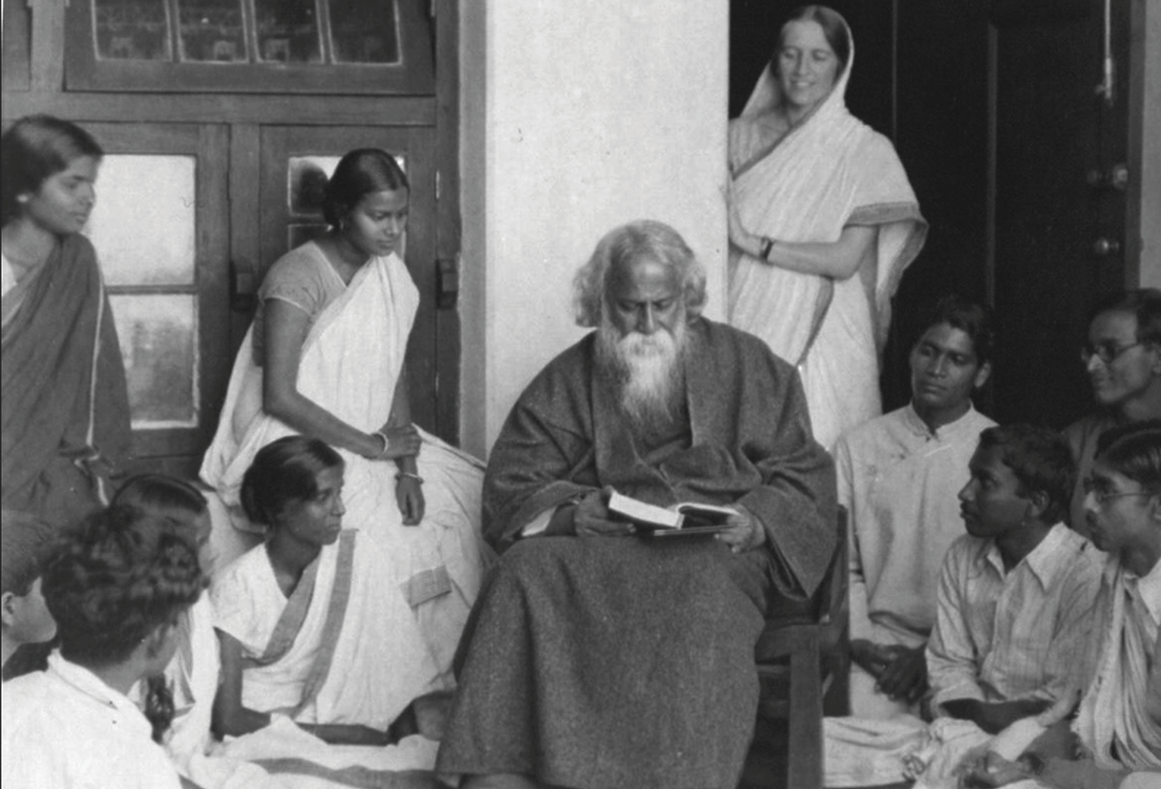
In 1901, his poetry adopted a more practical form. He founded a model school on his family estate in Santiniketan near Bolpur (meaning ‘the home of peace and tranquillity’), which is still operating today. The school combined Indian traditions with modern and thoughtful pedagogical methods, following the classical Greek model, establishing a kind of paradise on earth where a new era of Indian culture began. The students were educated amidst singing birds and flowering trees, in a beautiful garden, without the shackles of formal authority, including many games, singing and practical activities. Almost all the celebrities of the time visited the school, and those who saw it described it as a place where the air was filled with solemn, happy thoughts.
Tagore was unexpectedly awarded the Nobel Prize for Literature in 1913, earning the attention of the whole world, which was suddenly overcome by a feverish adoration of Tagore. He was thronged by crowds and his popularity soared to the point where he asked to be excused from the public eye. After the end of the world war, the weight of his message found even more receptive audiences around the world, and he became a poet-apostle of sorts. As a result of his influence, faith-infused ideas resurfaced in modern literature.
Tagore travelled throughout the world, visiting more than thirty countries across five continents. In 1926, the ailing Tagore visited Hungary during his European tour. He spent ten days at the Balatonfüred Cardiology Hospital and, in gratitude for his treatment, planted a sapling on the promenade that has since borne his name, with the following words: “I am planting this tree in resemblance of my stay here, which was more than hospitality. I have come to the land of a nation which is emotionally akin to India.” This radiant, active life ended where it began: at his birthplace in Jorasanko on 7 August 1941. Tagore left a legacy of fifty books of poetry, nineteen novels, forty plays, over two thousand songs and philosophical treatises for the seekers of posterity.
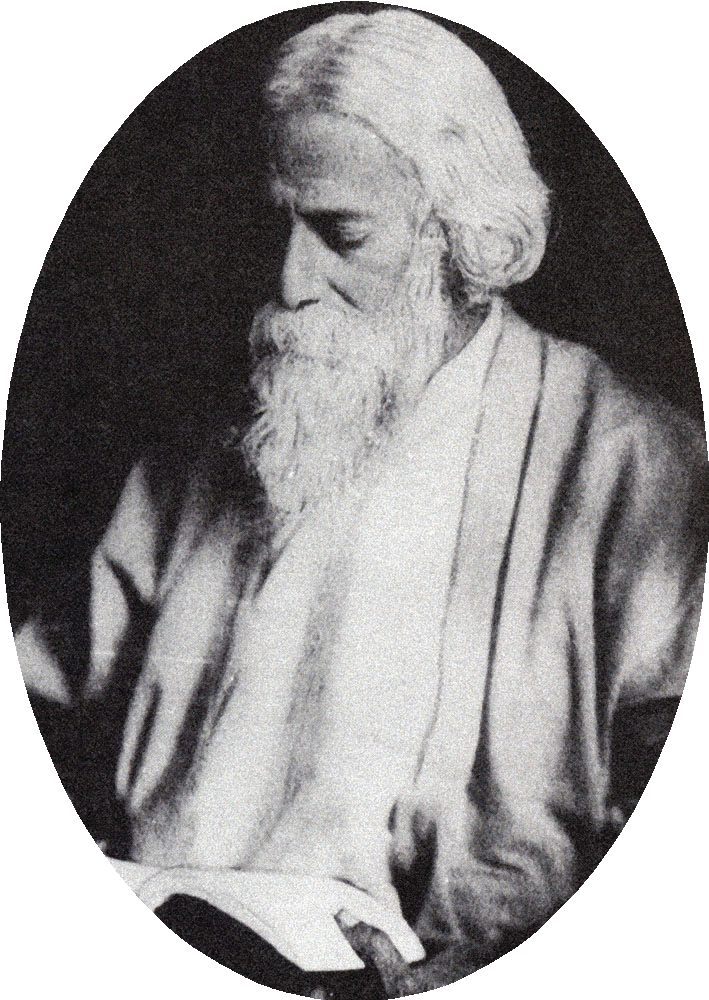
“The mountain remains unmoved by its seeming defeat by the mist. […] God among stars waits for man to light his lamps. […] I touch God in my song / as the hill touches the far-away sea.”
(excerpts from Rabindranath Tagore’s collection of poems entitled Fireflies)
“Do not go to the garden of flowers! O Friend! go not there; In your own body is the garden of flowers. Take your seat on the thousand petals of the lotus, and there gaze on the Infinite Beauty”
(excerpt from one of Kabir’s song in the interpretation of Rabindranath Tagore)
“At the immortal touch of thy hands my little heart loses its limits in joy and gives birth to utterance ineffable.”
(excerpt from Tagore’s collection of poems entitled Gitanjali – Song Offerings)
“I cling to this living raft, my body, in the narrow stream of my earthly years. I leave it when the crossing is over.”
(excerpt from Tagore’s poem entitled Crossing)
“But we do cross the infinite at every step, and meet the eternal in every second. Therefore some of our philosophers say there is no such thing as finitude; it is but a maya, an illusion. The real is the infinite, and it is only maya, the unreality, which causes the appearance of the finite. But the word maya is a mere name, it is no explanation. […] The freed soul delights in accepting bonds, and does not seek to evade any of them, for in each does it feel the manifestation of an infinite energy whose joy is in creation.”
(excerpts from Tagore’s work entitled Sadhana – The Realisation of Life)