Saint Thomas Aquinas
1225–1274, present-day Italy
Saint Thomas Aquinas, the great scholastic teacher and a leading thinker of the Catholic Church, also known as the “Angelic Doctor”, was born as a member of the noble family of the Counts of Aquino in Roccasecca, near Naples, on 28 January 1225. He began his studies at the Benedictine monastery in Monte Cassino, before going on to study at the university in Naples. He had a brilliant career ahead of him, yet at the age of nineteen – much to the consternation of his relatives – he asked to be admitted to the Dominican Order. His first mission took him to Paris, yet he was seized by his brothers and taken to his father’s castle.
Thomas devoted his time in captivity to study and prayer and became more strongly committed to his decision to become a monk. After fifteen months of imprisonment, he was freed by his brethren amidst adventurous circumstances, and was personally escorted by the head of the order to Paris. Here he was taught and supported by one of the most celebrated teachers of his age, Albertus Magnus (Saint Albert the Great), who quickly spotted the talent of the quiet and pious youth. Thomas spent years in close proximity to the grand master of scholasticism and served as his secretary for some time. Once, after failing to best Thomas in a debate, he foretold that “in his teaching he will one day produce such a bellowing that it will be heard throughout the world”.
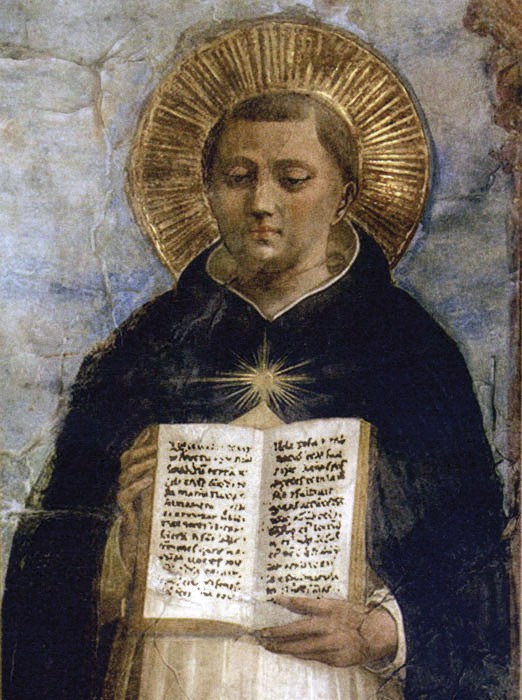
Scholasticism was the dominant philosophical current of Medieval Christianity, which had a great impact on the theoretical foundation of the Catholic Church. One of its main goal was to help man understand all that had been believed as divine revelation. The scholastics interpreted, systematised, and reorganised the knowledge of previous ages. Within this movement, the approach of Thomas Aquinas was known as Thomism – according to numerous researchers this was Aristotelianism transfused with the Christian impulse. Many consider the reform of scholasticism within exoteric Christianity to be of similar importance as the concurrent reform of Rosicrucianism within esoteric Christian schools of thought.
At the age of thirty-one, Thomas received from the Pope the right to public teaching, and he often represented the interests of the Church in negotiations. For years, he taught at the papal court and was involved in a number of historically important events of the Church. For example, in 1262, his intervention allowed for Blessed Eusebius to receive the papal approval to establish the Hungarian Order of Saint Paul. Thomas took over as head of the Order’s college in Rome. When he returned to Paris, he was appointed professor of theology and taught at the university. These years spent in Paris are considered the peak of his scientific work. This is when he wrote one of his main works, the Summa Theologiae, which served as a compendium and summary of the theological teachings of the Church. His friend and fellow confessor, Reginald of Piperno, accompanied him on all his important journeys and wrote down Thomas’ thoughts – he also became the subsequent custodian of his works.
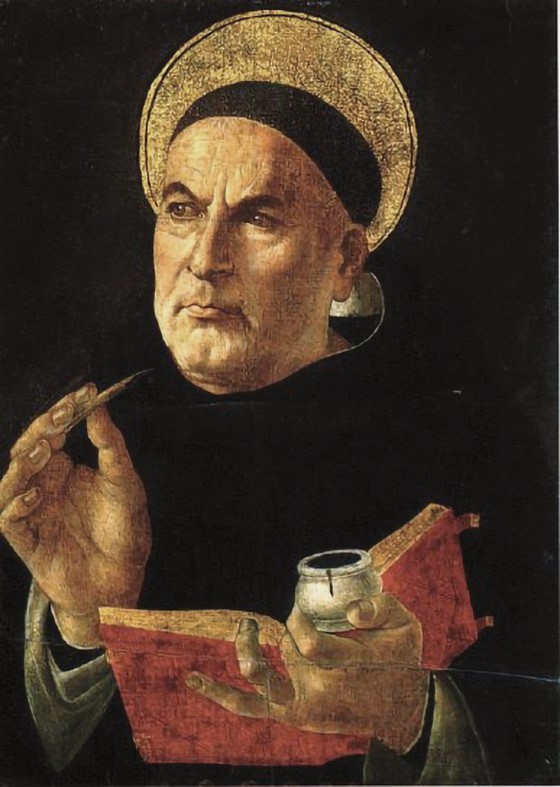
Yet despite his high offices and recognition, Thomas remained modest throughout his life, often appearing at the papal court in simple monastic robes, barefoot. His modesty is well illustrated by the story of a magister who failed to recognise him, calling out to him: “Hey, fat one! Your superior ordered you to accompany me and carry my belongings.” The barefoot Thomas humbly carried the magister’s parcel until a fellow monk noticed them and said, “Father Thomas, what are you doing?” In response to the magister’s pleading apology, Thomas simply said, “I have nothing to forgive. I will never be anything other than a servant of God.”
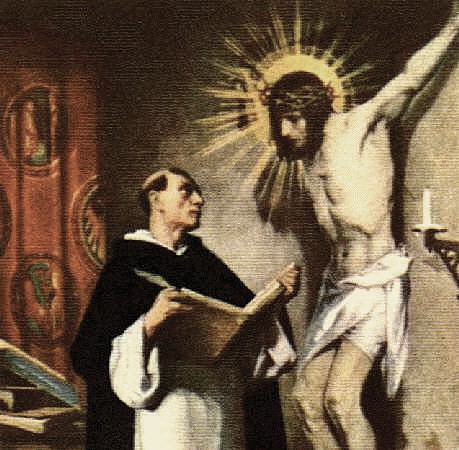
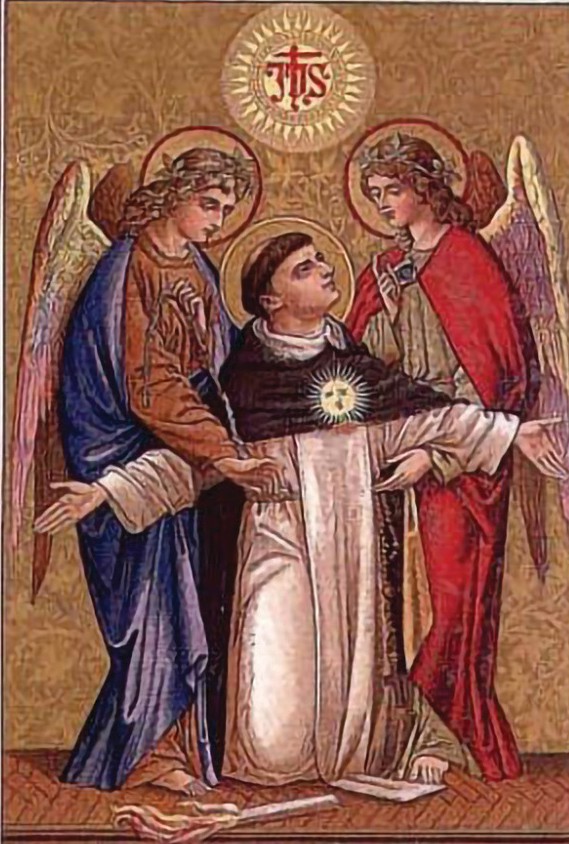
After many days of trance-like meditations, Thomas recorded his thoughts on paper in a crystal clear, comprehensible way, using the system of concepts he had developed. We also know that when he wished to engross himself in spiritual matters, he often reached out for the crucifix or the tabernacle for support. He witnessed his greatest spiritual experience when delivering mass in 1273. Supposedly, he never took up a pen again after this experience. In 1274, the Pope summoned Thomas to attend the Second Council of Lyon and he dutifully set out despite his bad health. However, on his way he became seriously ill and requested admittance to a Cistercian monastery. He departed the earthly realms on 7 March at the Abbey of Fossanova while pondering on how human thinking could be made Christian. Thomas was pronounced a saint in 1323. In 1879, Pope Leo XIII ordered all Catholic seminaries to teach his doctrines and study his works and in 1880, he was recognised as the patron saint of all Catholic educational establishments.
“But faith and hope attain God indeed in so far as we derive from Him the knowledge of truth or the acquisition of good, whereas love attains God Himself that it may rest in Him, but not that something may accrue to us from Him. Hence love is more excellent than faith or hope, and, consequently, than all the other virtues.”
“Only the least of us can receive revelation… by expelling pride, humility makes man submissive and always open to receiving the influx of divine grace.”
“Justice without mercy is cruelty.”
“It is the mystery of the Incarnation that is signified by this return of rivers to their source… These rivers are the natural goods with which God has filled his creatures–being, life, intelligence […] and the source from which they come is God […].”
“We have nothing to ask of God but that his will be done through us, that is, that God’s will be done in us.”
“No one can be truly happy without love.”
“If one fails to do what they can and expects a miracle from above, they are actually tempting God.”