Sariputra
5th-6th century BCE, India
Sariputra was one of the Buddha’s ten closest students and is also known as the wisest disciple of the Enlightened One. He stands out among the ten great disciples and is considered one of the Buddha’s two main disciples, along with Moggallana. The Buddha referred to him as the ‘King of the Dharma’ and often set him as an example for how the Sangha should practice and understand his teachings. He was repeatedly asked by the Buddha to ‘spin the wheel’ or teach the Dharma – no one else was allowed to do so for a long time. Sariputra received countless teachings directly from his master, including the five spiritual faculties and the doctrine of stillness.
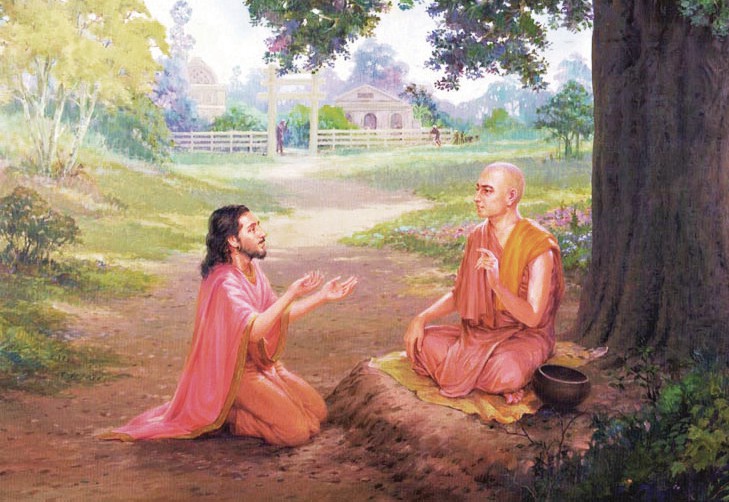
He is considered to be one of the first great Buddhist philosophers, and no one had a better grasp of the totality of the Buddha’s teachings than him. His systematic knowledge is still passed down in many Buddhist traditions. Before he became a disciple of the Buddha, he was known as Upatissa, after the name of the village where his father was the chief. As his first-born son, he heard of the Buddha from a travelling companion and understood the essence of the Enlightened One’s teachings from a conversation with him. He most probably then told his subsequent, so-called ‘monastic twin’ Moggallana that he had found the master they had been waiting for and together they sought out the Buddha after leaving their former teacher. The very first time they met, the Buddha predicted that Sariputra and Moggallana would do great things for the Buddhist community.
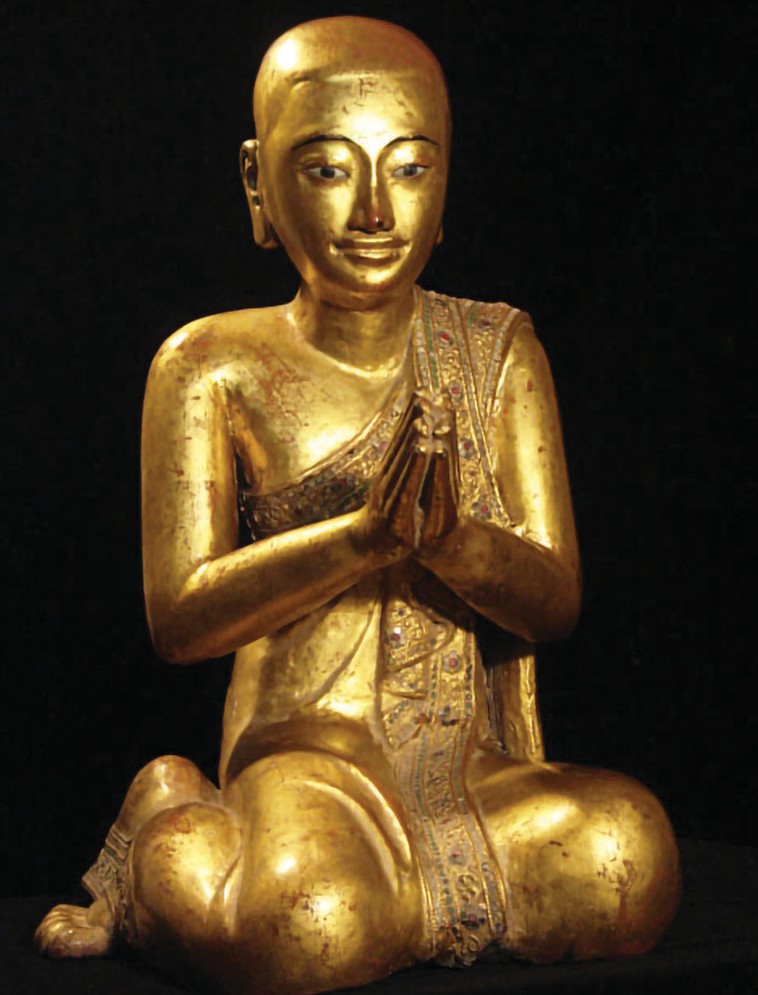
Just as in the case of the Buddha’s other disciples, little information has survived about Sariputra’s life as the focus is more on the teachings. It is said that two weeks after Moggallana’s enlightenment (immediately after meeting the Buddha), Sariputra also attained a form of enlightenment. This explains how he could have attained such great wisdom as an uneducated villager. Sariputra was able to convey the doctrine in a way that anyone could easily memorise it. As the Buddha’s ‘chief disciple’ he was responsible for the unity of the community, and when disputes arose, his authority was acknowledged by both parties. According to a legend, when the Buddha retired for a time during the first great crisis of the Sangha, it was Sariputra who established order.
When someone was in doubt or seriously ill, he was capable of reinvigorating them. He is said to have been capable of becoming perfectly attuned to the thoughts of others, so much so that he could see them almost directly. At the Buddha’s request, he ordained Rahula – the Buddha’s son – as a monk, with whom he developed a personal, tutelary relationship. He undoubtedly had much to give spiritually to his fellow monks, and there are many stories – such as the legend of Anuruddha (one of the ten chief disciples, the Buddha’s cousin) and the tale of Samitigutta, who suffered from leprosy as a result of his misdeeds in previous lives – that tell of how he managed to guide others to help awaken to themselves.
He also regularly supported Moggallana in his development, who in return provided Sariputra with medicine for two serious ailments. There are two different accounts of his death. According to the first, he passed away in his native village of Nalagamaka after converting his mother who was opposed to both the Dharma and the Sangha, while in the other version, he was captured by the Buddha’s enemies, beheaded and his head was sent to the Buddha. Sariputra is considered the second founder of the Theravada school of Buddhism, which is widespread in Sri Lanka and other countries. In this school, the emphasis is on exiting from the cycle of existence (Samsara): the ideal is to reach a high level of development (Arhat) from which it is no longer necessary to be reborn on Earth.
“Upon his death, Sariputra is said to have chanted, ‘I have loved and been faithful to my master, I have kept all the vows of the Buddha, now I lay down the heavy burden of my life for good, I will give no more room for rebirth.’ Then, turning to the monks around him, he continued, ‘Strive as hard as you can, so that you may achieve your goal. I can give you only this advice, nothing else. Behold, my departure is now consummated, I am now completely freed from all that I was.’” (excerpt from the Theragatha)
“On one occasion, when Sariputra met his brother-turned-hermit in a dry, thorny acacia forest, he sang this song to him: ‘In village or forest, mountain or valley, the enlightened Arhats are comfortable wherever they stay. The forest is a pleasant place because there are no crowds. Only those who are happy to be free of their passions, who have not come here to indulge their senses, find pleasure here.” (excerpt from the Theragatha)