
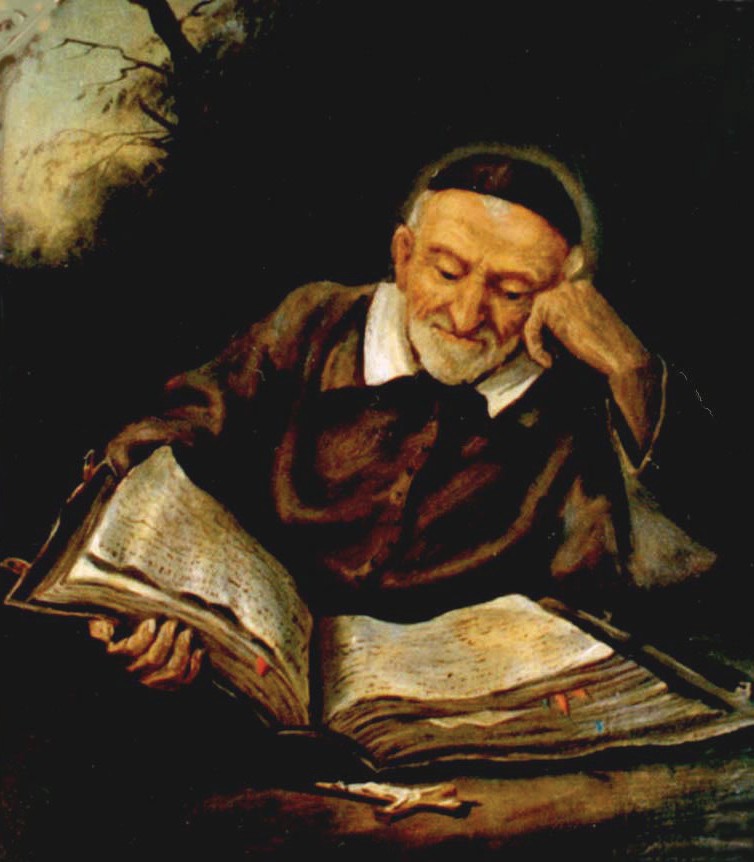
Vincent de Paul
1581–1660, France
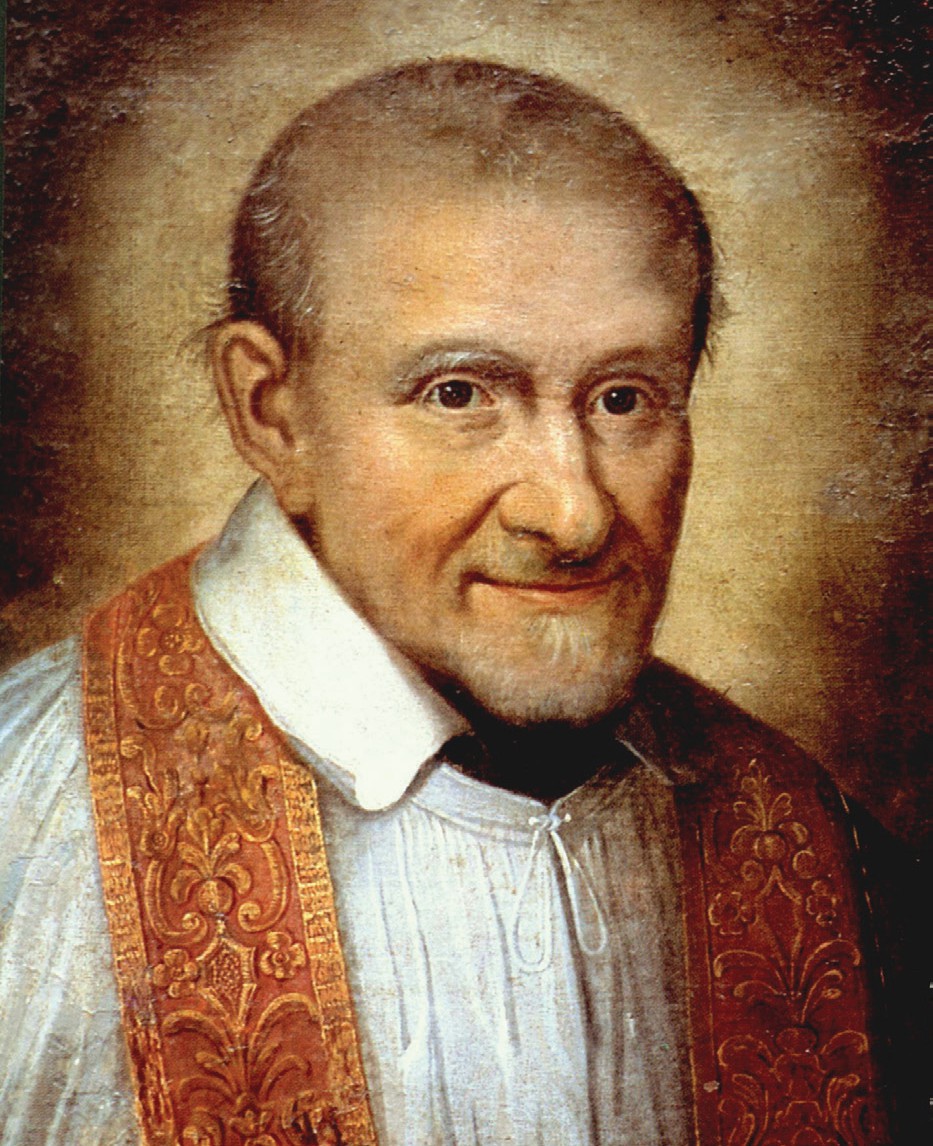
Vincent de Paul, Catholic priest and founder of the Vincentians and the monastic communities of the Vincentian family as well as one of the great pioneers of charity movements was born on 24 April 1581 in Pouy, a small village in the south of France as the son of poor peasants. As a child, he contributed to the family’s livelihood by tending to the animals. His parents saw that one of the ways out of poverty for their child was to have them trained as a priest. At the age of fifteen, Vincent began the preparations for his vocation at a Franciscan College in Dax, before continuing his studies in Zaragoza, Spain, and then in Toulouse. He was ordained as a priest at the age of 19, and four years later he graduated in theology.
He was unable to find a position at any parish, while his debts were mounting. After a series of unsuccessful attempts, a widow in Toulouse left him in her will a sum of one thousand two hundred francs, which required him to travel to Marseille. On his return trip, the ship was assailed by pirates and he was captured and sold as a slave in Tunis. He had several masters: first a fisherman, then an alchemist, and finally a Franciscan-turned-Muslim. He managed to convert the latter and together they set out from Tunis to Avignon.
In 1610, he became chaplain and spiritual adviser to Henry IV’s first wife, and soon afterwards he was granted the benefice of a Cistercian abbey. In 1612, he was sent to the parish of Clichy, near Paris, and served as tutor for the family of Count Gondi, who commanded the royal galleys. The family soon took a liking to him, yet after three years he resigned his tutorship and took charge of a parish in the diocese of Lyon in 1617. In 1617, on the feast of the conversion of Saint Paul, he gave a sermon on the general confession of one’s life which deeply moved the hearts of those who heard him that so that after the mass all those in attendance performed the confession. He later returned to the Gondi family and established other Confraternities of Charity in the villages on the family estates. He started his work with galley slaves on Easter 1618.
He realised that he could help them not by taking over their oars, but rather by fighting for more humane conditions for them. By taking over the Saint Lazarus complex of buildings, he took on the spiritual care of the mentally ill and found the first companions who, like him, were willing to engage in missionary work. From 1643, they established houses abroad, one after the other. In the same year, they founded the ‘Daughters of Charity’, which later became known as the ‘Sisters of Charity’.
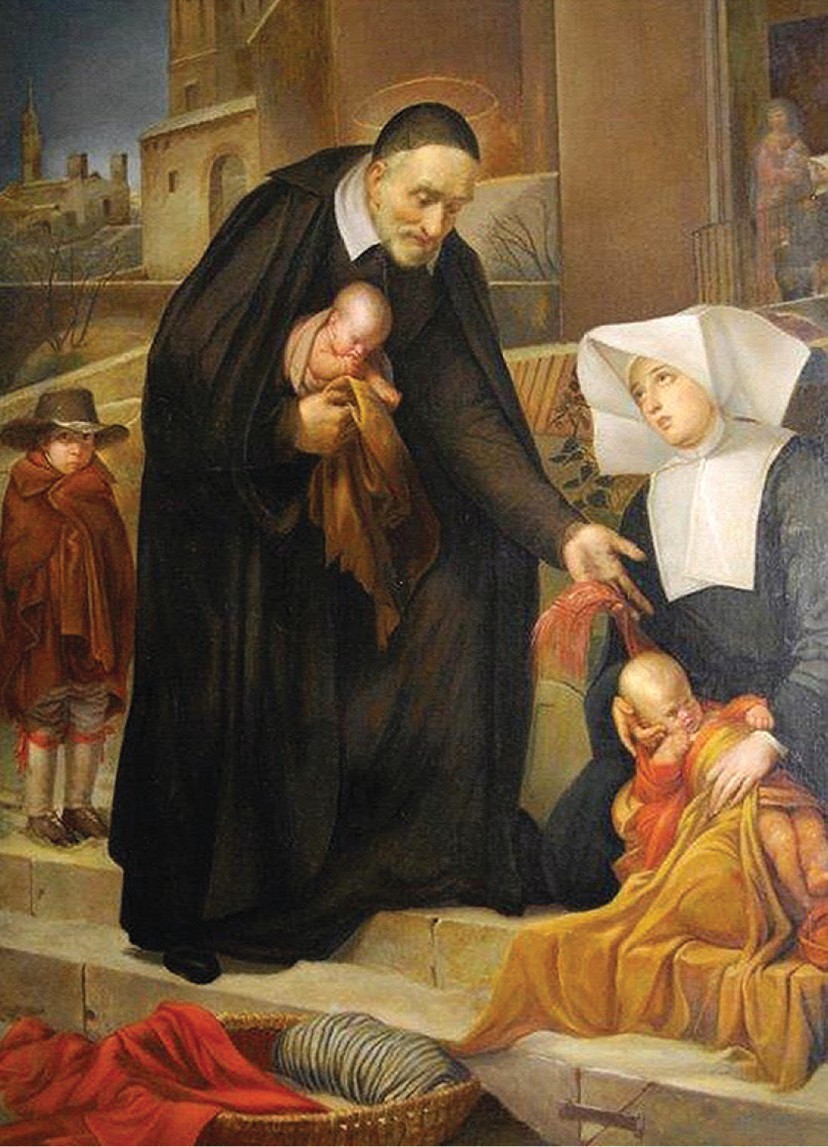
In 1640, he founded another institution to care for children orphaned in the Thirty Years War. The records show that this simple priest raised more money for war-torn regions than all the banks in France at the time. He sent grain and seed, and bought ploughs and tools for the devastated farms. He sent entire caravans of food and clothing to the needy. In Paris, he organised for the care of the refugees: he established the St Lazarus shelter and warehouse, and organised soup kitchens. He drafted and printed pamphlets to inform people of the means of protecting themselves against epidemics. He sent poignant messages to the more well-off provinces to stir up the generosity of the people. The Lazarist monks and the Sisters of Charity helped bury the bodies left in the streets and fields.
He handled this utmost confusion with complete serenity: he supervised and led those around him, overseeing all matters without ever getting upset and ensuring that help always arrived everywhere on time. Towards the end of his life, he suffered from bouts of swamp fever. From 1655, he was severely ill and eventually, he was completely unable to work and almost entirely paralysed. He passed away on 27 September 1660. He was subsequently beatified in August 1729 and canonized in 1737. “I never considered what I was doing to be anything spectacular, I simply did what I had to,” he said of himself. In 1828, his hometown adopted his name in his honour. To this day, the Vincentian monastic communities continue to help the needy in countless different ways.
“The poor are your breviary and litany! That shall suffice for you. Your convent will be the house of the sick; your cell, a hired room; your chapel, the parish church; your cloister, the streets of the city or the wards of the hospital. Treat the poor well, for they are your masters.”
“Let us place our confidence in God and set ourselves in complete dependence upon His providence. Then we need not worry about what others say of us or do to us, for it will all turn out to our advantage.”
“It is the shame of Paris that the people here are treated like animals. These little ones are truly God’s children, because no one fulfills their duty as a father for them. For them, God is the father and the mother who takes care of them. He is delighted in their chatter, listens to their cries and their weeping. It is a great duty to raise God’s beloved children! It is a great honour, a happy, holy work!”
“Once we are empty of ourselves, God will fill us with Himself, for that sort of emptiness has a providential purpose Let us therefore humble ourselves.”
“Our rule is the Saviour himself, who wished to be surrounded by the obsessed, the foolish, and the mad.”



